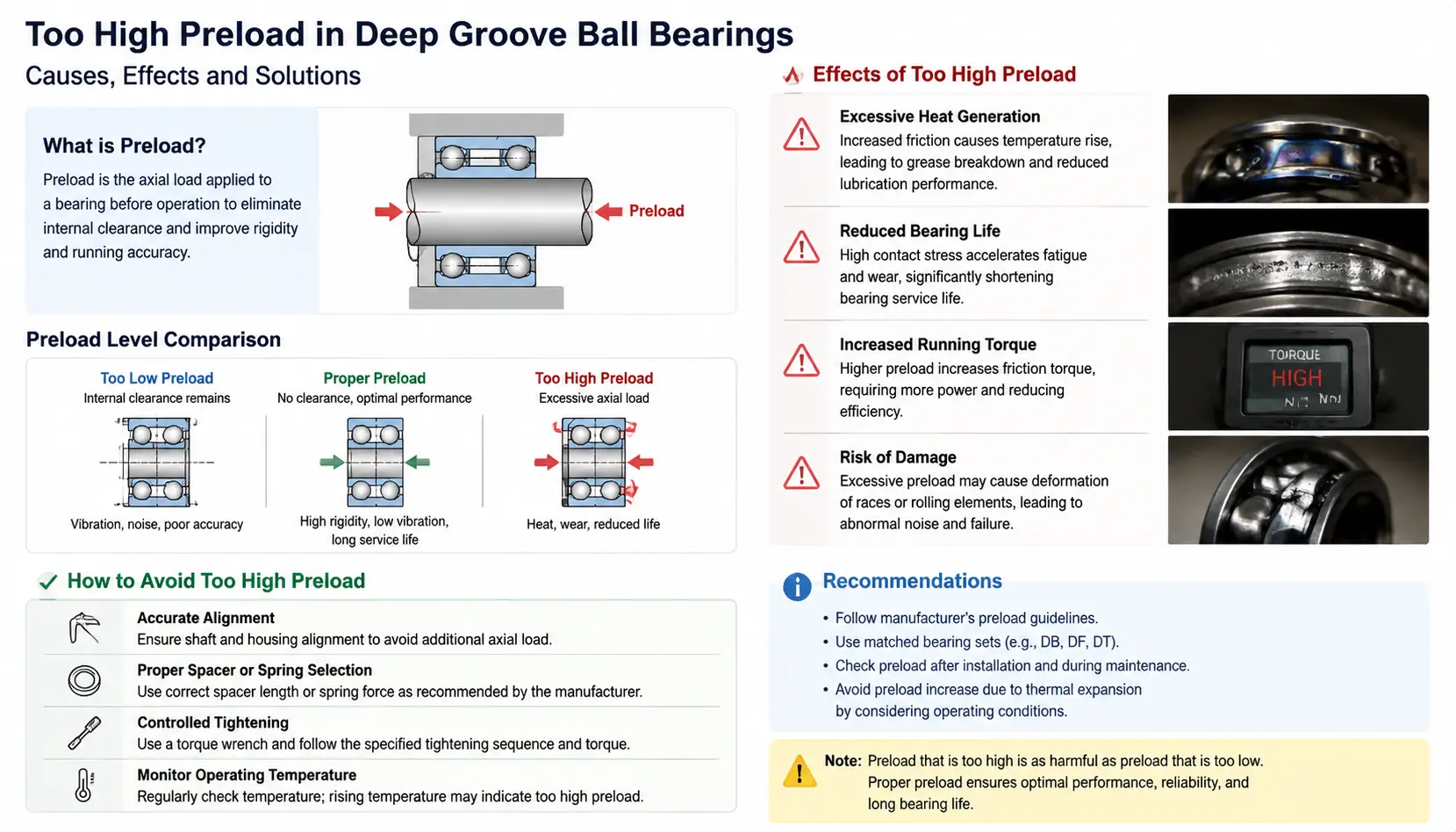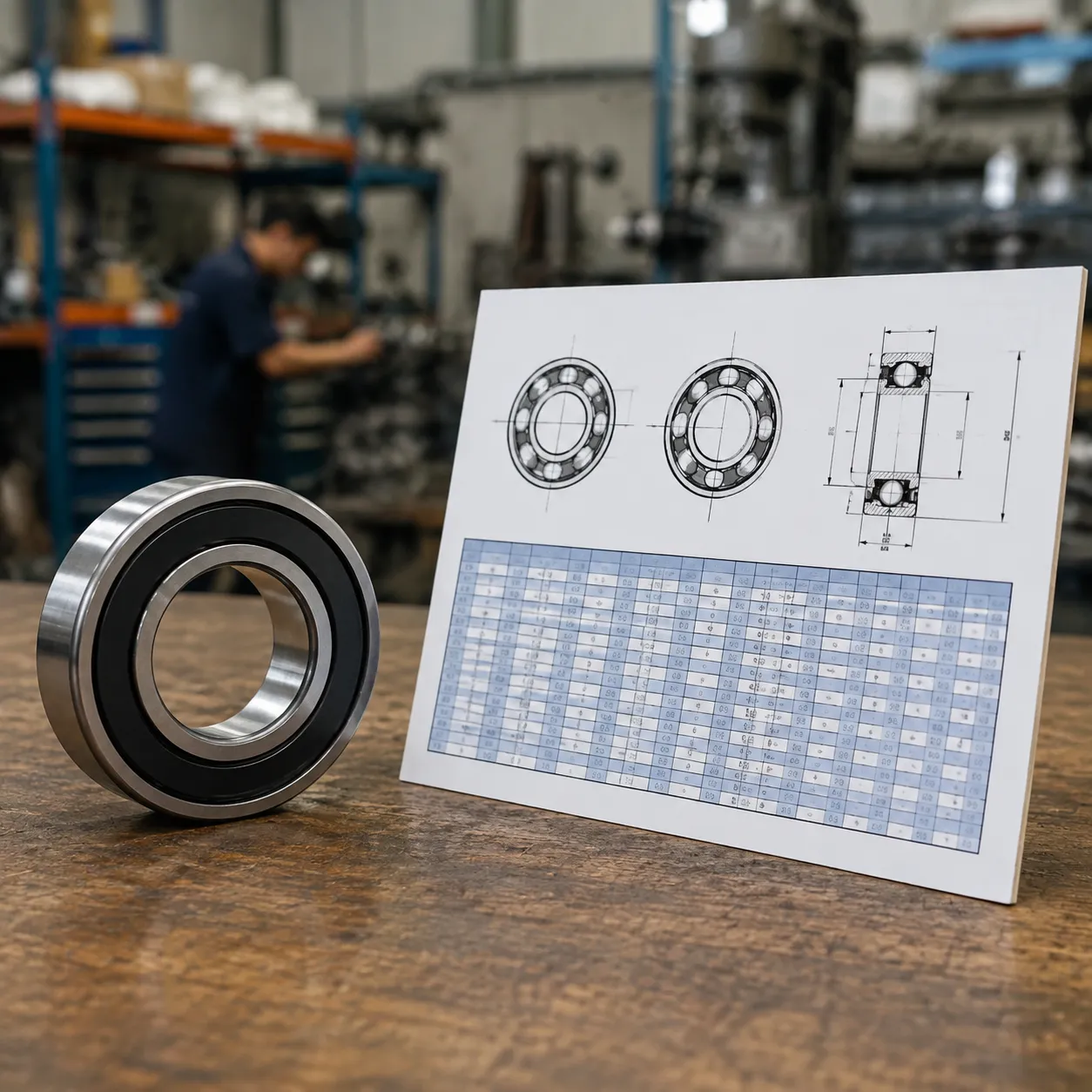
Combined-duty shafts need deep groove ball bearings radial and axial loads held inside catalog limits—a deep groove ball bearings axial load review starts with raceway geometry, radial clearance, and bearing size, not guesswork on thrust load alone.
- Typical Fa band: Many single row designs carry roughly 15–50% of static radial rating (C0) as permissible thrust load — exact cap depends on speed, fit, and groove fill
- Life drivers: Excessive axial share raises rotating friction, heat, and shortens bearing service life
- Clearance: C3/C4 allows higher contact angle under load vs CN — pairs with dynamic load equivalent (P = X·Fr + Y·Fa)
- Escalation path: Continuous high axial forces may need angular-contact rows or single direction / double direction axial deep-groove units (not standard self-retaining deep-groove rows)
Compare load-class programs in radial deep groove ball bearings or the selection guide axial load vs radial load in deep groove ball bearings.
Deep Groove Ball Bearings Axial Load — Radial & Thrust Basics
Managing Multi-Directional Forces
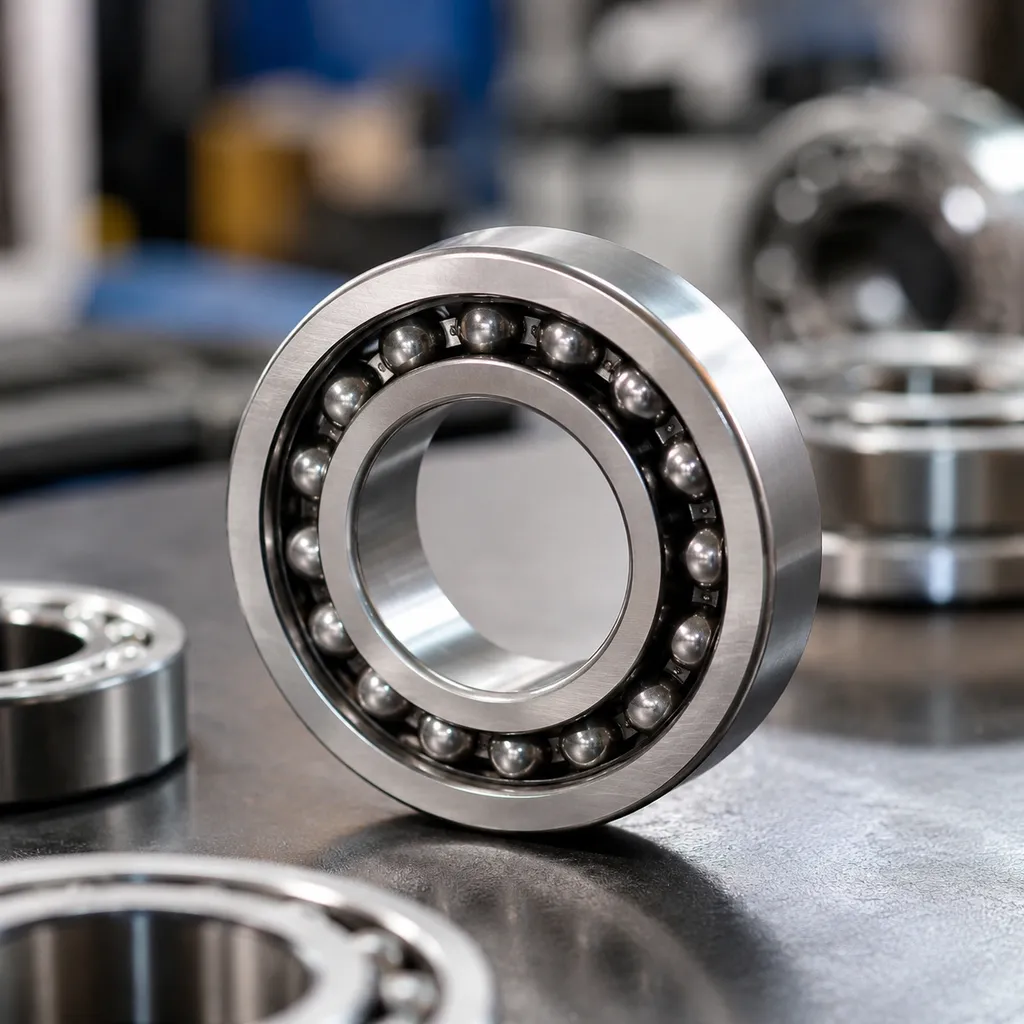
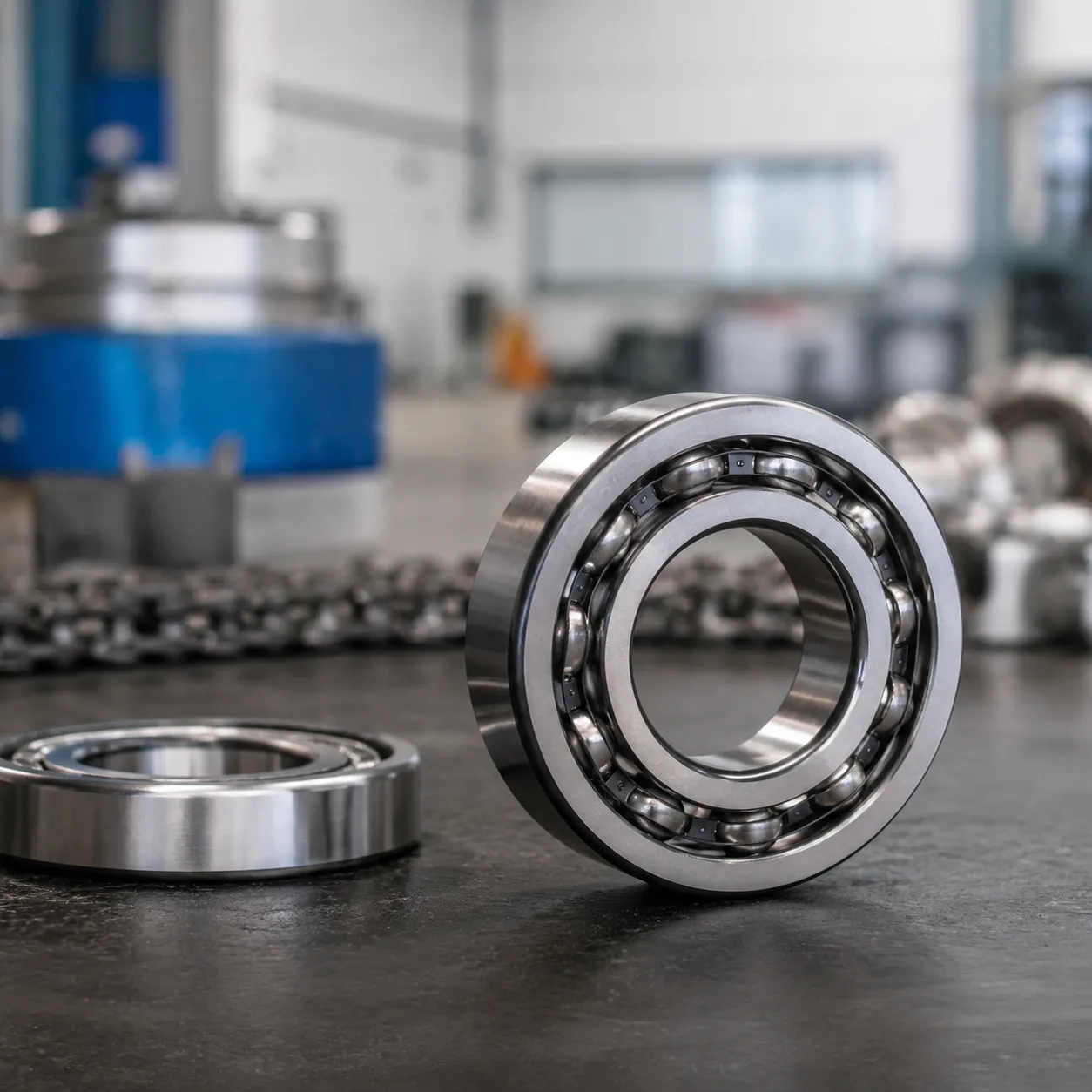
Single row deep groove ball bearing units feature deep, uninterrupted raceway grooves. This geometry supports both deep groove ball bearings radial and axial loads simultaneously. When thrust load is applied, balls track up the raceway shoulder on the inner ring and outer ring, allowing reliable operation under combined stress.
Axial vs Radial Load Capacity Limits
While highly versatile, these bearings have clear boundaries:
Primary design: Optimally handles pure radial forces perpendicular to the shaft.
Axial capacity: A standard deep groove ball bearing can often support permissible thrust load up to 25% to 50% of its static radial load rating, depending on bearing size and internal geometry.
The risk: Exceeding these limits forces balls too high on the groove edge, causing severe rotating friction, heat buildup, and shortened bearing service life.
Why Contact Angle Matters for Thrust Loads
In an un-loaded state, a deep groove ball bearing has a 0° nominal contact angle under load. When thrust load is applied, internal radial clearance allows a small shift.
- As the inner ring shifts axially relative to the outer ring, a dynamic contact angle forms.
- Larger internal clearance (C3 or C4) increases this operational contact angle.
- A higher contact angle yields a higher thrust load limit before premature failure.
Deep Groove Ball Bearings Axial Load — Permissible Thrust Ratings
While a single row deep groove ball bearing is primarily designed for radial forces, it can handle meaningful thrust load when sized correctly. Generally, a standard unit can safely carry permissible axial load of up to 15% to 25% of its static load rating (C0), though heavy-duty or optimized setups can exceed that baseline when speed and lubrication allow.
Calculating the Permissible Axial Load
To determine thrust load limit for your application, balance radial forces and axial forces into an equivalent dynamic load.
When pure thrust load is applied, the calculation simplifies, but axial force (Fa) must not exceed the limit that forces balls too high on the raceway shoulder.
- Pure radial load: P = Fr
- Combined load: P = X·Fr + Y·Fa
Where X is the radial factor, Y is the thrust factor, and P is the equivalent dynamic load. If Fa / Fr exceeds a limiting factor, axial share heavily dictates bearing service life.
Radial Internal Clearance and Thrust Capacity
Internal clearance directly determines contact angle under load. Tighter clearance means less room for balls to shift, which can limit thrust capacity at speed.
| Internal Clearance Grade | Axial Displacement | Thrust Load Capacity | Best Used For |
|---|---|---|---|
| CN (Standard) | Low | Moderate | Standard electric motors, light machinery |
| C3 (Greater than CN) | Medium | Higher | High-speed applications, heavier thrust forces |
| C4 (Greater than C3) | High | Highest | Extreme temperature shifts, maximum axial load margin |
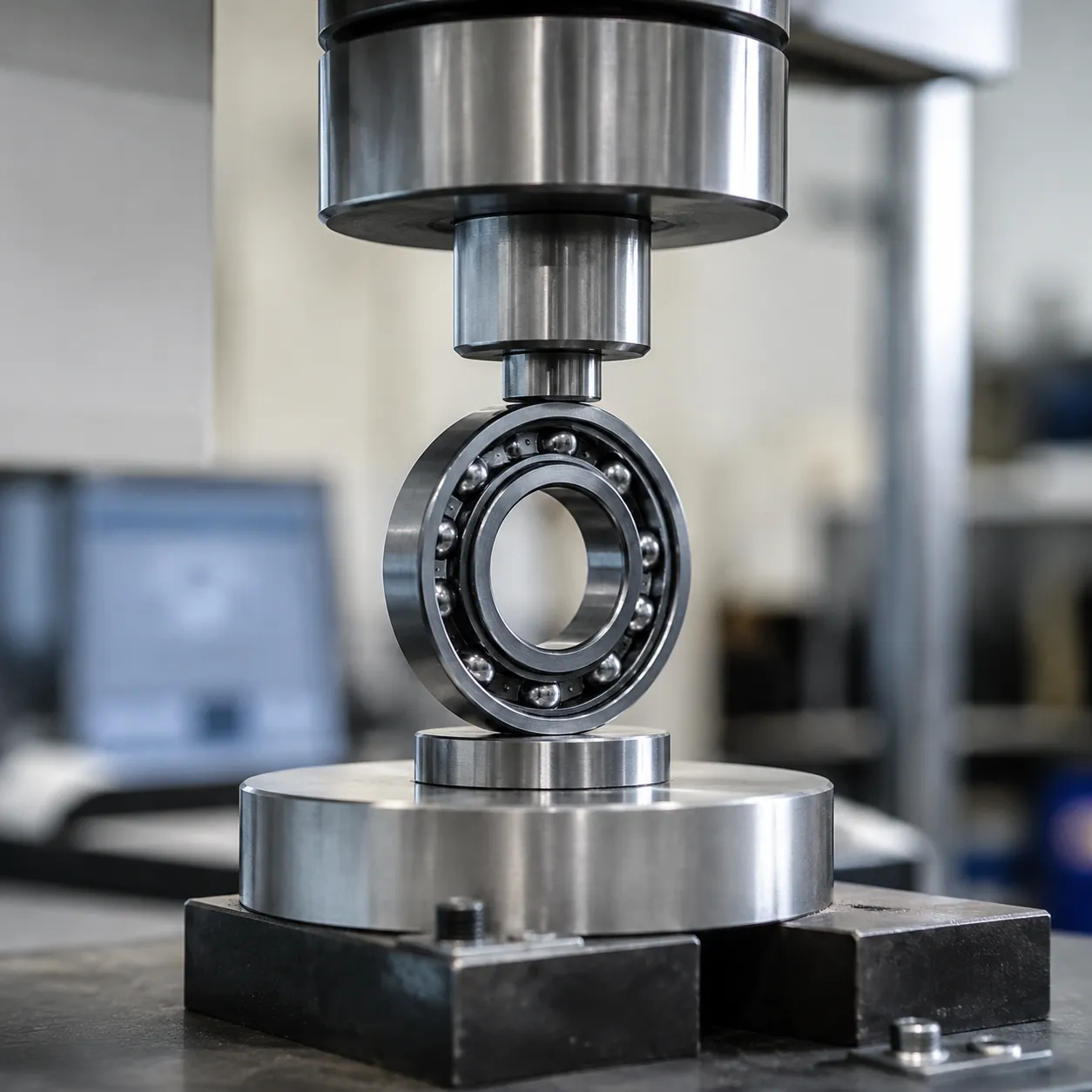
Opting for C3 or C4 radial clearance allows a higher contact angle under axial force, boosting total thrust load limit versus CN fits on the same bearing size.
How Speed and Lubrication Impact Axial Force Limits
High operating speeds generate severe rotating friction when a bearing is under heavy axial stress.
- Heat generation: Axial forces push balls against inner ring and outer ring shoulders, adding sliding friction beyond pure rolling.
- Lubrication breakdown: Under high axial forces, grease can leave the contact zone; continuous thrust loading needs EP additives or oil-mist supply.
- Speed limits: As speed increases, allowable axial load factor drops to preserve bearing service life.
- Minimum load: At speed, too-light radial forces (below catalog minimum load) cause skidding and extra rotating friction — size up or preload when Fa is dominant.
Thrust Load Limits — Clearance, Cage, Filling Slots & Speed
Ultimate deep groove ball bearings axial load capacity depends on configuration as much as catalog C0.
Cage Design and Stability
- Pressed steel cages: Lightweight, reliable, normal temperatures.
- Machined brass cages: Heavy vibration or sustained high axial forces.
- Nylon/polyamide cages: High speeds and quiet running within temperature limits.
Standard Grooves vs Filling Slots
Single row bearings with filling slots accept more balls for radial duty but reduce permissible thrust load versus standard full-width grooves — do not specify slotted rows when bidirectional axial share is significant.
Choosing the Right Bearing Internal Clearance
| Clearance Grade | Best Used For | Impact on Axial Capacity |
|---|---|---|
| CN (Normal) | Standard applications with minimal axial displacement. | Baseline thrust load limit. |
| C3 (Greater than CN) | High-speed or high-heat applications. | Increases axial load capacity by allowing a higher contact angle. |
| C4 (Greater than C3) | Heavy interference fits and high axial loads. | Maximizes thrust capacity but requires careful alignment. |
High-Precision Grades for Axial Performance
Heavy axial loading benefits from tighter running tolerances and honed raceways. Precise geometry reduces rotating friction, prevents uneven ball loading, and distributes deep groove ball bearings radial and axial loads evenly across rolling elements.
Deep Groove vs Angular Contact Ball Bearings for Axial Loading
When to Stick with Deep Groove Ball Bearings to Save Costs
Single row deep groove ball bearing designs fit applications dominated by radial forces with light to moderate thrust load. When axial share stays inside permissible limits, standard deep-groove geometry keeps replacement cost low.
When to Switch to Angular Contact or Axial Deep Groove Units
Continuous high axial forces may require angular contact bearings or dedicated axial deep-groove rows. Axial deep groove ball bearings are available in single direction or double direction ready-to-fit units that support high axial forces and are not self-retaining like standard radial rows — match the architecture to thrust direction and mounting.
Cost vs Performance Under Continuous Axial Stress
- Deep groove ball bearings: Cost-efficient for light, intermittent thrust load; suffer wear and heat under continuous axial overload.
- Angular contact / axial deep groove: Higher initial cost; better durability when Fa dominates or single direction thrust is continuous.
| Performance Metric | Deep Groove Ball Bearings | Angular Contact / Axial Deep Groove |
|---|---|---|
| Primary load handling | High radial forces, light thrust | Heavy thrust load plus radial share |
| Axial force capacity | Limited (often up to ~50% of radial capacity context-dependent) | Optimized for axial stress; double direction options where needed |
| Initial component cost | Economical | Higher investment |
| Life under thrust | Reduced if permissible limits exceeded | Maximized under heavy continuous stress |
Tips to Maximize Deep Groove Ball Bearing Life Under Axial Stress
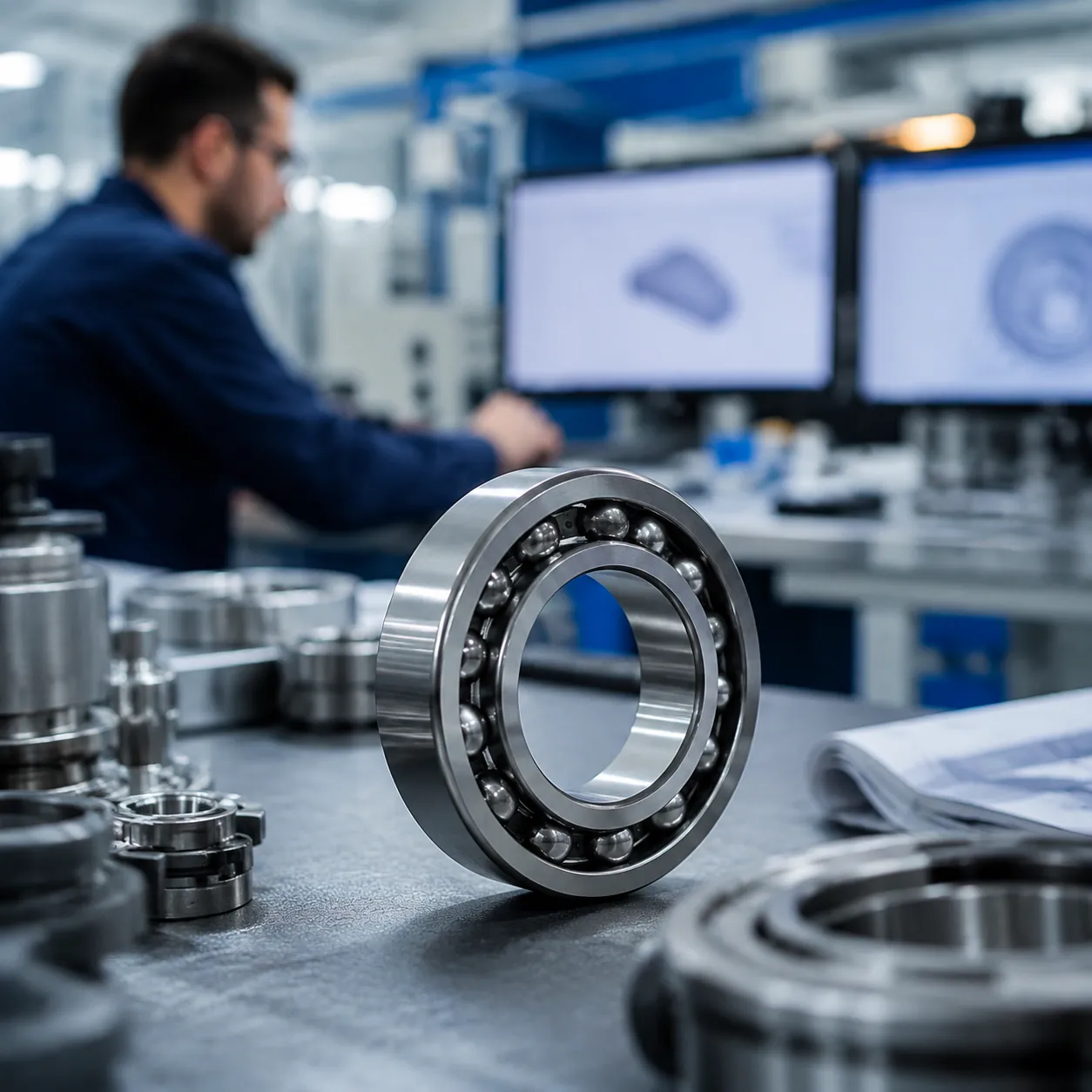
Applications with sustained deep groove ball bearings axial load need precise mounting, lubrication, and inspection to protect bearing service life.
Proper Mounting Techniques
- Use the right tools: Never strike rings directly; use press sleeves or induction heaters.
- Check shaft shoulders: Keep housing and shaft shoulders square to limit misalignment under thrust load.
- Apply force correctly: Press only on the ring experiencing the tight fit.
Selecting High-Pressure Grease
| Lubricant Feature | Why It Matters for Axial Loads |
|---|---|
| EP (Extreme Pressure) Additives | Prevents metal-to-metal contact when loads spike. |
| High Base Oil Viscosity | Maintains a thicker film at operating temperatures. |
| Shear Stability | Resists breakdown under continuous mechanical shearing. |
Routine Maintenance Signs
- Vibration changes: Micro-vibrations often mean poor ball tracking under heavy axial forces.
- Temperature spikes: Sudden heat signals increased rotating friction or grease starvation.
- Discolored grease: Metallic flecks indicate raceway wear from excessive thrust load.
Deep Groove Ball Bearings Axial Load FAQ
Can 6200 series bearings handle axial loads?
Yes. Single row deep groove ball bearing programs including 6200 series support deep groove ball bearings radial and axial loads. Primary duty is radial forces; deep raceways carry bidirectional thrust load within catalog Fa limits for the chosen bearing size.
What happens if you exceed the thrust load limit?
- Misalignment: Inner ring and outer ring shift; balls ride raceway edges.
- Rotating friction: Temperature spikes and lubrication breakdown.
- Cage failure: High axial forces can collapse the cage and seize the unit.
How to do an axial force calculation?
Use static load rating (C0), radial clearance, and combined-load formula for equivalent dynamic load. Allowable thrust load often stays within ~50% of C0 for standard grooves when radial share is low — recalculate P = X·Fr + Y·Fa whenever both radial forces and Fa are present.
Are shielded or sealed bearings better for axial forces?
| Bearing Type | Axial Performance Impact | Best Used For |
|---|---|---|
| Shielded Bearings (ZZ) | Non-contact shields; maintains catalog speed ratings under thrust. | High-speed, clean environments. |
| Sealed Bearings (2RS) | Contact seals add slight friction but retain grease under heavy loads. | Contaminated or outdoor environments. |
Closure type does not change steel load capacity, but seals help retain grease when high axial forces raise operating temperature.
Do filling-slot bearings change axial load rating?
Yes. Filling slots boost radial ball count but cut bidirectional thrust load capability versus standard single row grooves — specify only when Fa is negligible.
Ordering Information — Deep Groove Ball Bearings for Axial Load Duty
Quote single row deep groove programs by series, bearing size, clearance (CN/C3/C4), seal (open / ZZ / 2RS), and expected Fa/Fr ratio. Standard MOQ from 500 pcs; mixed clearance batches for MRO and OEM lines.
| Program | Typical MOQ | Quote turnaround |
|---|---|---|
| 6200–6300 series stock | 500 pcs | 24–48 hours |
| C3/C4 clearance OEM | 1,000 pcs | 3–5 business days |
| Angular / axial upgrade path | 500 pcs | Engineering review + layout |
Request a Quote
Send shaft speed, Fa and Fr values, radial clearance target, and series preference for a deep groove ball bearings axial load sized proposal.
Contact JN Bearings with bore/OD/width, seal code, and whether minimum load at speed is a concern.