
Clean. Quiet. Precise.
Medical Devices Bearing Solutions.
JN Bearings manufactures high-precision ball bearings engineered for the strict hygiene, low noise, and stable accuracy requirements of modern medical equipment.
Designed for environments where operational smoothness and reliability are critical, our bearings ensure consistent performance across diagnostic, analytical, and surgical applications.
Core Requirements for Medical Device Bearings
Medical equipment operates in highly regulated environments where operational stability, acoustic control, and hygiene are absolute prerequisites. Unlike standard industrial settings, a bearing failure or minor performance inconsistency in a healthcare device can compromise diagnostic accuracy, disrupt clinical workflows, or pose risks to patient safety. That is why specifying the right bearings for medical equipment requires a fundamentally higher standard of engineering.
The demands placed on medical devices bearings extend far beyond basic load capacities and speed ratings. Sourcing teams and design engineers must carefully evaluate rotational smoothness, noise signatures, surface cleanliness, and long-term consistency under demanding continuous-duty cycles. The sections below break down these critical performance metrics.
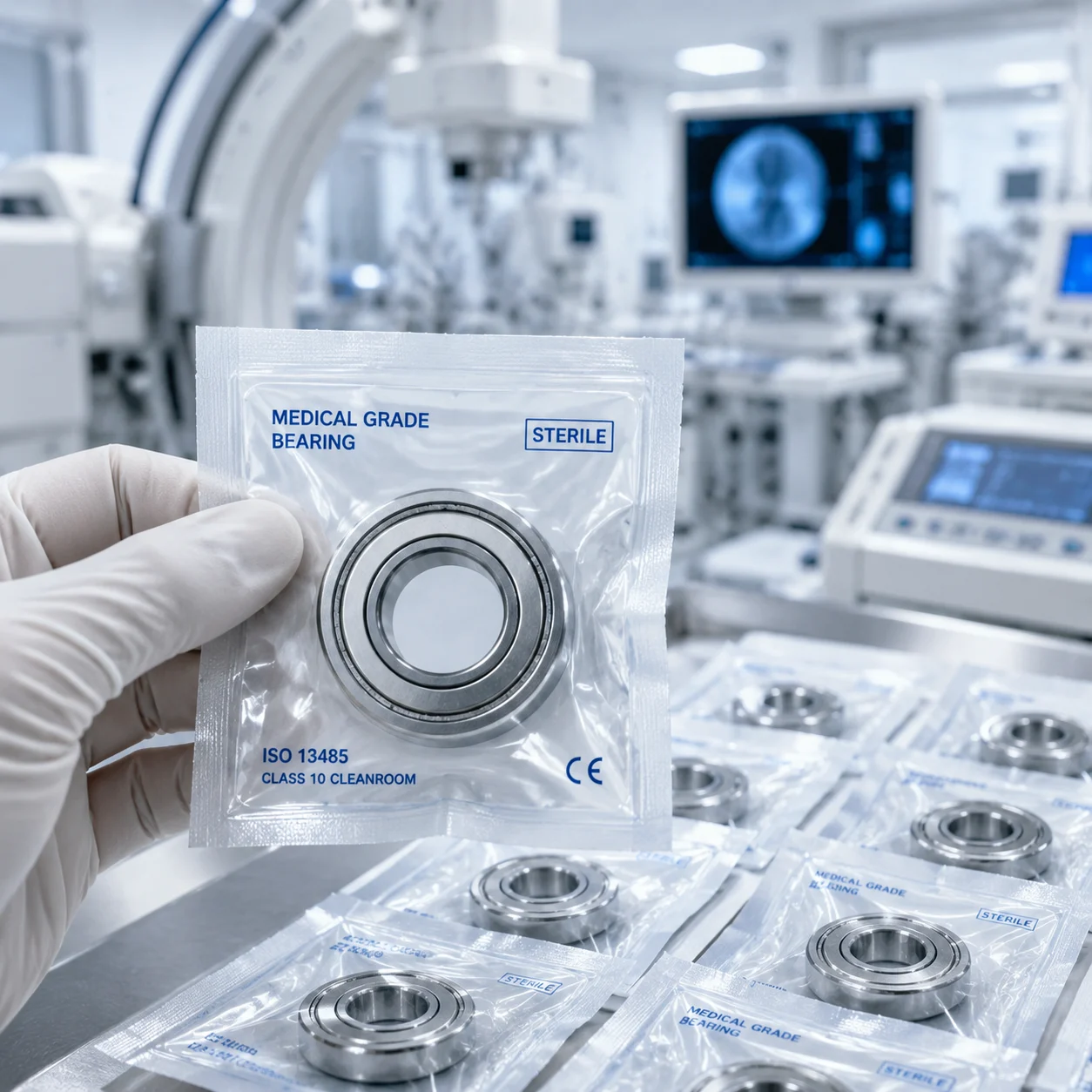
Why Healthcare and Clinical Applications Demand More
Standard commercial bearings are built for general mechanical loads and cost-efficiency. However, rotating components in medical technology cannot tolerate vibration-induced image artifacts, audible humming during patient diagnostics, or particulate contamination inside sterile fluid pathways.
Whether operating in high-speed dental handpieces, laboratory centrifuges, automated surgical robots, or diagnostic imaging gantries, rotary motion must be exceptionally smooth, stable, and clean. Any deviation from these strict specifications compromises the core functionality of the medical device.
Through rigorous manufacturing and quality control processes, JN Bearings helps medical equipment manufacturers achieve stable, consistent rotational performance, ensuring both device reliability and optimal clinical outcomes.
Common Engineering Challenges in Medical Bearing Selection
Design engineers sourcing high precision bearings for healthcare devices frequently navigate complex design constraints. Overcoming these challenges is the first step toward a successful product lifecycle:
- Constrained installation spaces. Miniaturized device architectures leave minimal room for standard bearing envelopes, demanding highly compact, thin-section, or miniature precision alternatives.
- Continuous duty operation. Clinical environments often require equipment to run for extended diagnostic shifts. Bearings must deliver uncompromised performance and resist wear across thousands of operating hours.
- Restricted maintenance windows. Medical devices operate in heavily scheduled clinical cycles. Unplanned downtime for component replacement is disruptive and financially costly for healthcare providers.
- Strict cleanliness protocols. Components used near sterile fields or within controlled laboratory spaces require clean room bearings that prevent lubricant outgassing and resist particulate shedding.
- Exposure to aggressive fluids. Frequent sterilization cycles and harsh cleaning agents necessitate advanced corrosion resistance, utilizing medical-grade stainless steel and protective surface treatments.
Key insight: In medical applications, bearing selection directly impacts overall device performance and regulatory compliance. Specifying purpose-built low noise bearings or low vibration bearings from the initial design phase mitigates redesign risks and streamlines equipment certification.
Low Noise Operation
Acoustic PerformanceDiagnostic environments, especially those involving patient monitoring or imaging, are acoustically sensitive. Audible interference from a bearing during an MRI or sleep study can disturb patients and disrupt results. Using quiet bearings with optimized raceway geometries and specialized lubricants is essential for these applications.
Low Vibration and Smooth Rotation
Rotational StabilityMicro-vibrations in rotating assemblies are a primary cause of image artifacts in CT scanners and ultrasound systems. Even slight bearing runout can distort critical diagnostic data. Low vibration bearings with superior form tolerances and perfectly balanced rolling elements deliver the rotational stability that advanced imaging equipment demands.
High Precision and Accuracy
Dimensional AccuracyRobotic surgery platforms, laser alignment tools, and laboratory automation rely on bearings with exceptionally tight dimensional tolerances for exact positioning. High precision bearings eliminate mechanical play and positional drift, safeguarding procedural accuracy and preventing sample handling errors.
Cleanroom Suitability and Durability
Cleanliness and LongevityRotary components within sensitive clinical equipment must not introduce contaminants. Clean room bearings made from high-grade stainless steel, utilizing sealed configurations and specialized non-shedding lubricants, ensure assemblies remain chemically inert and withstand stringent sterilization protocols.
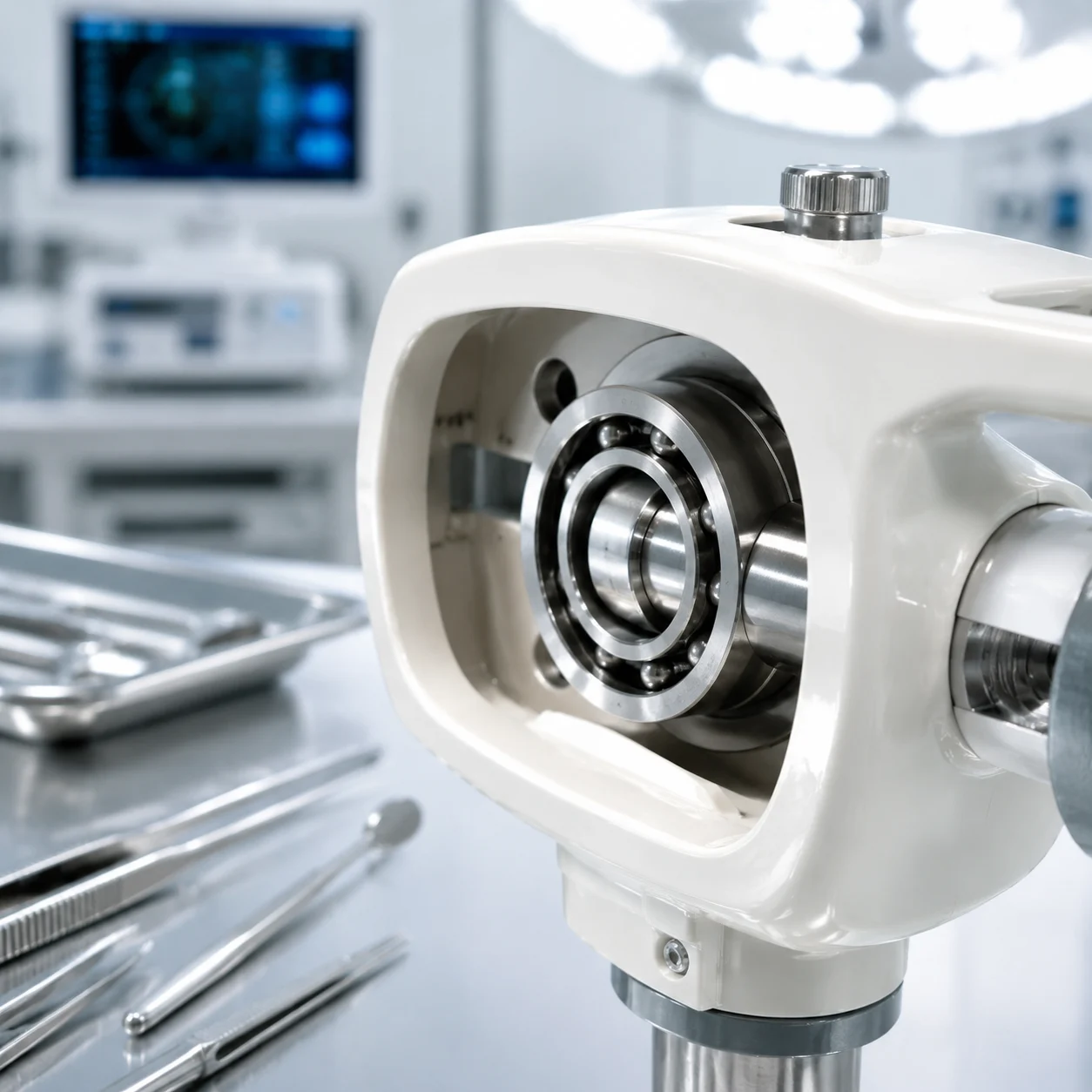
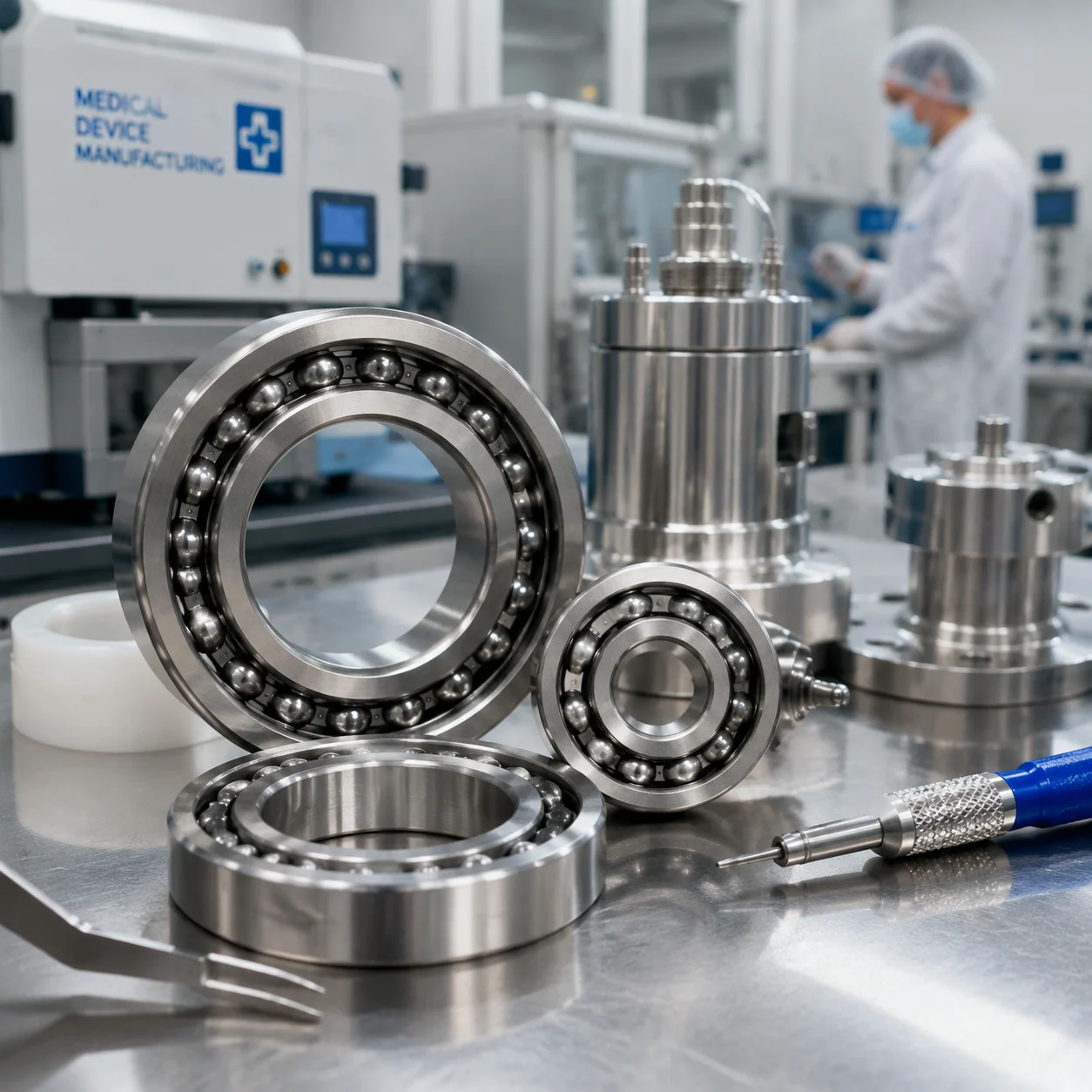
Stainless steel miniature ball bearings — optimally suited for compact medical assemblies demanding strict hygiene and enduring corrosion resistance.
Medical Bearing Requirements at a Glance
| Requirement | Impact on Medical Devices | Typical Applications |
|---|---|---|
| Low Noise | Prevents acoustic disturbance in patient-facing clinical environments | MRI gantries, ultrasound equipment, sleep diagnostics |
| Low Vibration | Eliminates rotational micro-vibrations that cause imaging artifacts | CT scanners, X-ray tubes, high-speed centrifuges |
| High Precision | Ensures precise, repeatable positioning for automated mechanics | Surgical robots, laser cutting optics, sample analyzers |
| Cleanroom Compatibility | Prevents particulate and outgassing contamination in sterile areas | Clean room bearings for lab automation, IV pumps |
| Corrosion Resistance | Withstands repeated exposure to aggressive chemical disinfectants | Dental handpieces, surgical power tools, wash stations |
Precision Bearings for Medical Equipment
From diagnostic imaging to life-support ventilators, JN Bearings provides scenario-specific solutions. Different devices prioritize different levels of cleanliness, noise control, and accuracy.
Diagnostic Equipment
MRI and CT scanners require extremely smooth movement. The bearing focus is on angular contact ball bearings for non-magnetic properties and strict noise control.
- Non-magnetic materials
- Quiet bearings for patient comfort
- Smooth high-speed rotation
Lab & Testing Devices
Centrifuges and blood analyzers involve high speeds and chemicals. The bearing focus is on micro-precision and robust corrosion resistance, including miniature precision bearings.
- Precision miniature sizes
- Corrosion-resistant steel
- High accuracy for stable results
Transmission Components
Surgical robots and powered hand tools demand flawless articulation. The bearing focus relies on strict clean room standards and sterile lubrication, with thrust ball bearings supporting high positioning precision.
- Clean room bearing standards
- Medical-grade lubrication
- High positioning precision
Precision Auxiliary Devices
Infusion pumps and ventilators operate continuously. The bearing focus is on low friction, durability, and absolute zero-maintenance reliability, often using deep groove ball bearings.
- Maintenance-free operation
- Consistent low friction
- Continuous-duty endurance
Medical Equipment Bearings Quick Reference
Different devices prioritize different levels of cleanliness, noise control, and accuracy.
| Equipment Category | Typical Applications | Key Bearing Type | Critical Requirement |
|---|---|---|---|
| Diagnostic Equipment | MRI, CT Scanners, X-Ray | Thin Section, Angular Contact | Non-magnetic, ultra-low noise |
| Lab & Testing Devices | Centrifuges, Blood Analyzers | Miniature Deep Groove Ball Bearings | High precision bearings, anti-corrosion |
| Transmission Components | Surgical Robots, Power Tools | Sealed Ball Bearings, Thrust | Clean room compatible, sterile |
| Precision Auxiliary Devices | Infusion Pumps, Ventilators | Deep Groove Ball Bearings | Long-term stability, continuous duty |
Tailoring Precision Bearings for Medical Equipment
Every medical application has unique priorities regarding cleanliness, acoustics, and precision. An ultra-quiet bearing for an MRI room serves a vastly different purpose than a highly sealed, corrosion-resistant bearing inside a laboratory centrifuge.
JN Bearings provides matching recommendations based on your specific speed, load, and installation space. We help you navigate the complexities of selecting bearings for medical devices, ensuring compliance and long-term rotational stability.
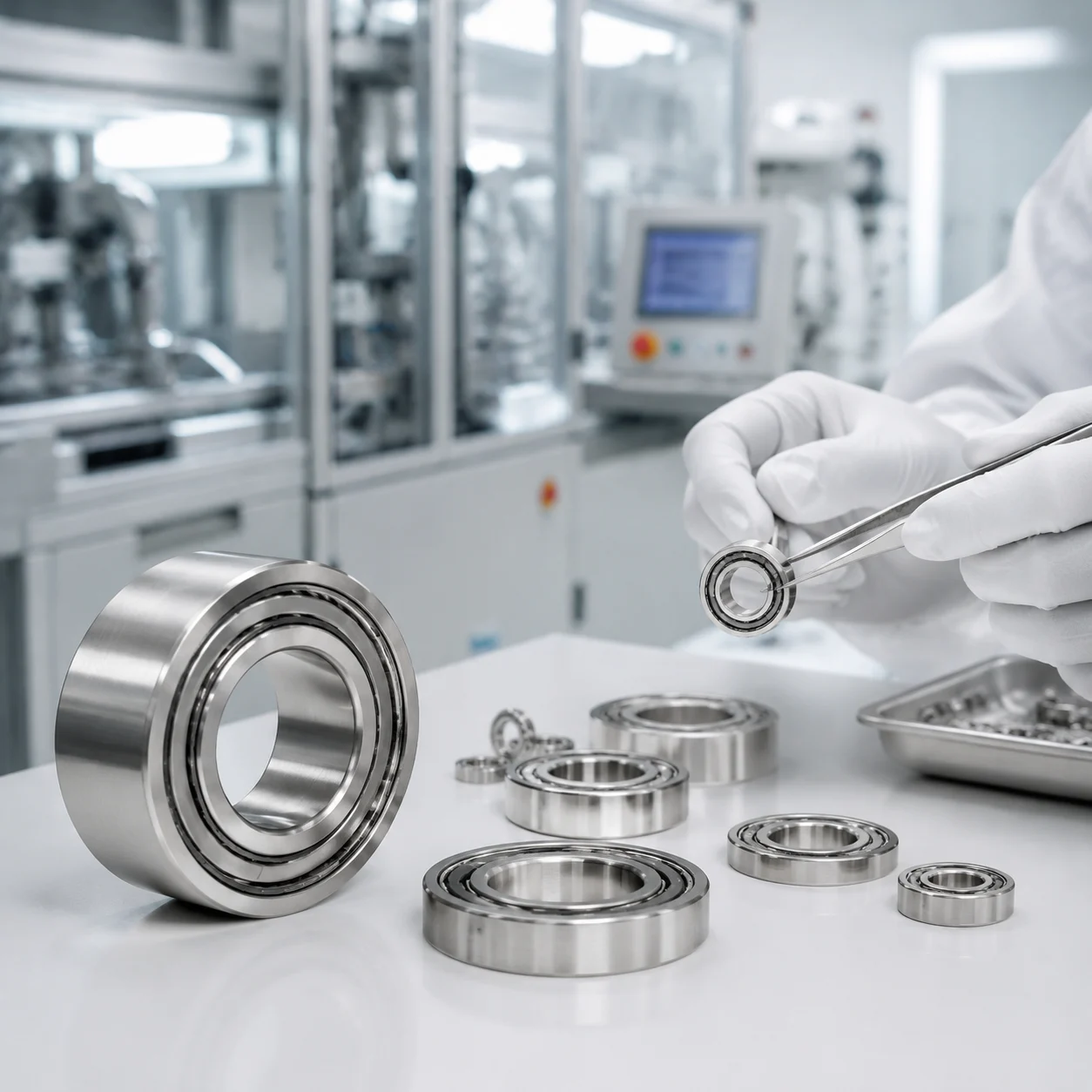
Need Bearings for Medical Devices?
Share your speed, load, and spatial requirements. JN Bearings will recommend the ideal precision bearings for your medical equipment.
Key Performance and Selection Dimensions
Specifying the right bearing for medical equipment requires translating clinical requirements into measurable engineering criteria. The four dimensions below outline the core factors engineers must evaluate when selecting quiet bearings, low vibration bearings, and corrosion-resistant solutions for sensitive healthcare applications.
Accuracy and Rotational Stability
In medical imaging and robotic surgery, rotational stability directly impacts diagnostic clarity and procedural safety. Precision accuracy is essential; even minimal radial runout or axial play can cause imaging artifacts in CT scanners or tracking errors in robotic arms. Bearings must maintain strict dimensional tolerances across high-volume production batches.
Key factors for ensuring rotational accuracy include:
- ✓Tolerance Classes — Higher precision grades (P5, P4) minimize runout for sensitive diagnostic imaging components.
- ✓Internal Clearance — Standard or reduced (C2) clearances enhance stiffness and positioning accuracy under varying loads.
- ✓Dimensional Roundness — Strict OD and bore geometry control prevents housing deformation during press-fit installation.
- ✓Batch Consistency — JN Bearings ensures unit-to-unit uniformity to support seamless OEM manufacturing integration.
Noise and Vibration Control
Quiet bearings are critical in patient-facing environments to prevent anxiety and discomfort. Furthermore, low vibration bearings are necessary to protect delicate optical sensors and analytical fluidic systems from mechanical interference. Acoustic and mechanical smoothness is a primary selection criteria for laboratory centrifuges and respiratory devices.
To achieve optimal noise and vibration control, consider:
- ✓Vibration Velocity — Utilizing specific testing metrics (e.g., ANDERON limits) to guarantee smooth operational performance.
- ✓Ball Quality — Utilizing Grade 10 or Grade 5 steel/ceramic balls significantly reduces rolling friction and micro-vibrations.
- ✓Cage Design — Non-metallic cages, such as PEEK, dampen acoustic noise during high-speed rotation compared to steel cages.
- ✓Lubricant Management — Applying precise quantities of low-noise grease prevents churning sounds while ensuring adequate film thickness.
Cleanroom Compatibility and Surface Condition
Medical devices operating in ISO-classified environments demand clean room bearings that eliminate particulate shedding. From pharmaceutical manufacturing to surgical theaters, contamination control extends from the bearing's surface finish to its specialized lubrication and sterile packaging requirements.
Essential specifications for cleanroom applications:
- ✓Particulate Control — Compliance with ISO 16232 standards to strictly limit maximum allowable particle contamination.
- ✓Controlled Assembly — Manufacturing and assembly in cleanroom environments to prevent embedded debris.
- ✓Specialized Lubricants — Utilizing medical-grade, low-outgassing, or food-safe greases to mitigate chemical risks.
- ✓Protective Packaging — Vacuum-sealed, individual clean packaging prevents environmental exposure prior to final installation.
Corrosion Resistance and Long-Term Reliability
Exposure to harsh cleaning chemicals, saline, blood, and steam sterilization (autoclaving) requires robust corrosion resistance. Stainless steel bearings (like AISI 440C or 316) offer the necessary longevity where standard chrome steel fails, ensuring the continuous, reliable operation of surgical tools and diagnostic equipment.
Criteria for ensuring chemical and environmental resilience:
- ✓Material Selection — 440C stainless steel for a balance of load capacity and rust prevention; ceramic options for extreme environments.
- ✓Sealing Technologies — Contact rubber seals (RS) or non-contact stainless shields (ZZ) block fluid and contaminant ingress.
- ✓Sterilization Compatibility — Specifying bearing materials and greases that withstand repeated high-temperature autoclave cycles.
- ✓Lifespan Reliability — Aligning the bearing's calculated L10 fatigue life with the medical device's intended duty cycle.
Balancing Complex Requirements
Selecting the ideal bearing involves balancing multiple parameters. A solution needing extreme accuracy must also meet the corrosion resistance demands of surgical environments. JN Bearings simplifies this process. As dedicated ball bearing specialists, we analyze your speed, load, dimensional constraints, and environmental factors to recommend a solution that optimizes both performance and manufacturing consistency.
Review the comparison chart below, and contact our engineering team to discuss customized specifications for your next medical device project. For more technical resources, see our guides.
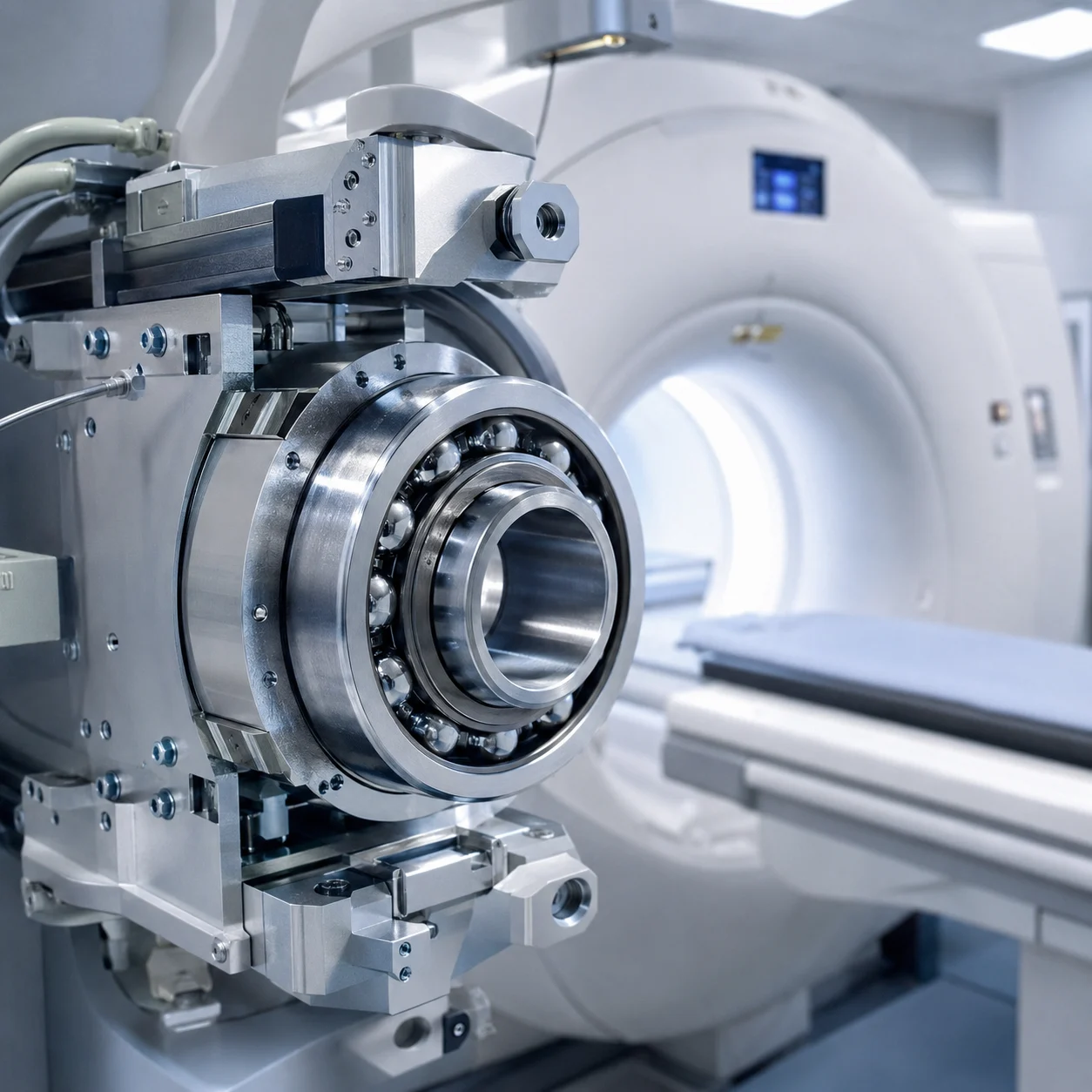
Key Specification Tags
Requirements by Application
| Requirement | Imaging (CT/MRI) | Lab Automation | Surgical Tools |
|---|---|---|---|
| High Accuracy | ●●● | ●● | ●●● |
| Quiet Operation | ●●● | ●● | ●● |
| Cleanliness | ●● | ●●● | ●●● |
| Corrosion Resist. | ● | ●● | ●●● |
●●● = Critical Focus ●● = Standard Requirement ● = Secondary
Need Custom Selection Support?
Provide your operational speeds, load capacities, space constraints, and environmental requirements. JN Bearings will engineer a tailored ball bearing solution for your specific medical equipment.
Request Selection Advice
Reliability You Can Measure.
Quality You Can Trust.
When lives and diagnoses depend on equipment stability, component quality is non-negotiable. JN Bearings provides globally recognized bearing manufacturer capabilities dedicated to serving medical equipment procurement requirements.
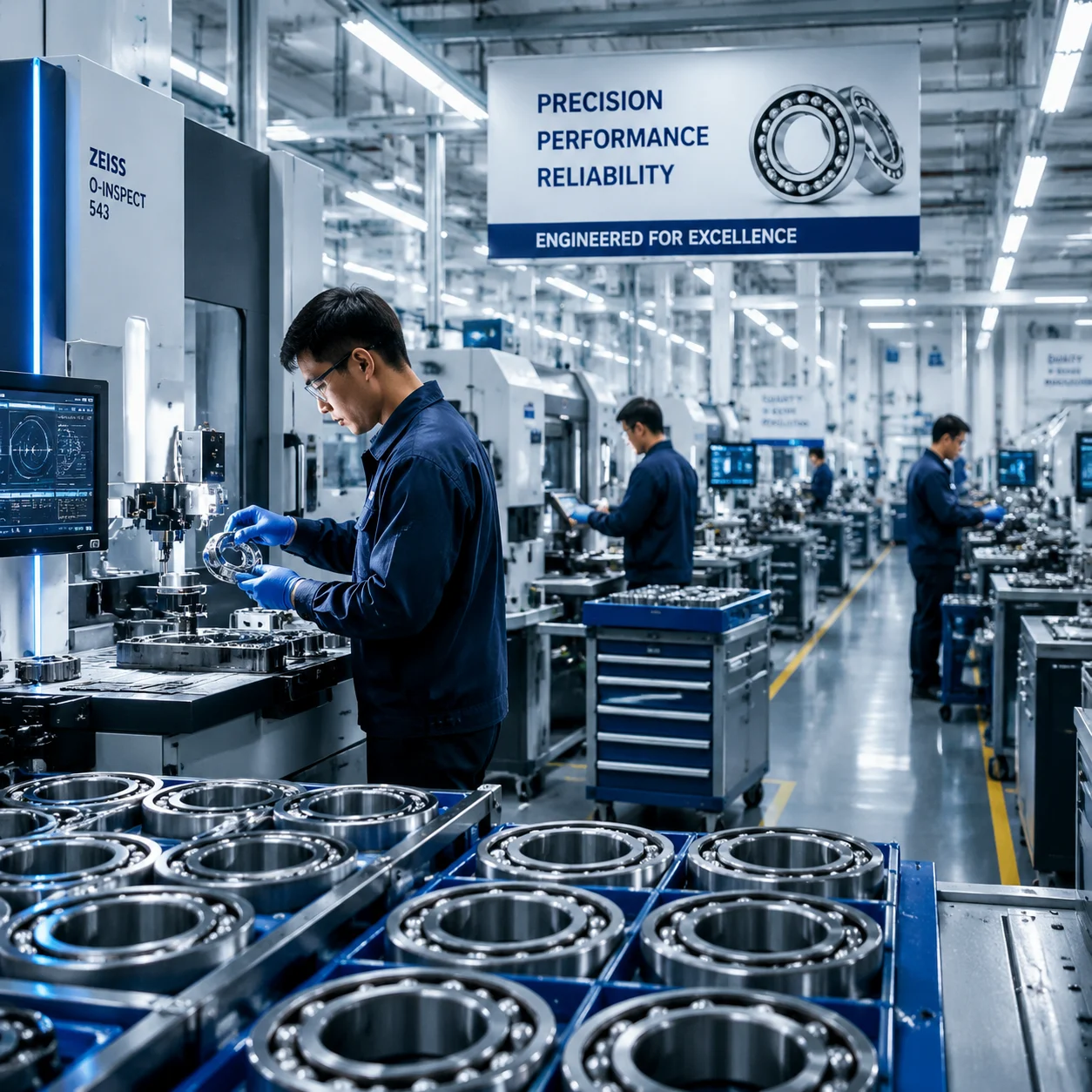
A Focused Bearing Manufacturer for High-Consistency Demand
Unlike generalist suppliers, Jinan Bearing Manufacturing Co., Ltd. focuses strictly on ball bearing engineering. This specialization allows us to maintain the tight tolerances and material integrity required for bearings for medical equipment, ensuring dependable performance without sudden batch variations.
- Specialized Production: Focused solely on precision deep-groove-ball-bearings
- Stringent Quality Control: Minimizing lot-to-lot variance for medical use
- Flexible Customization: Modifying dimensions, seals, and lubrication to fit
- Global Supply: Providing predictable lead times and reliable shipping
Precision Engineering
Adhering to strict tolerance levels to guarantee smooth rotation, low vibration, and extended operating life in medical environments.
Batch Consistency
Rigorous process inspections maintain uniform quality across thousands of units, essential for large-scale medical device production.
Stable Global Supply
Robust supply chain management ensures medical manufacturers receive components on time, reducing production downtime.
Application Support
Our team assists with bearing sizing, material selection, and lubrication strategies tailored for clean rooms and medical devices.
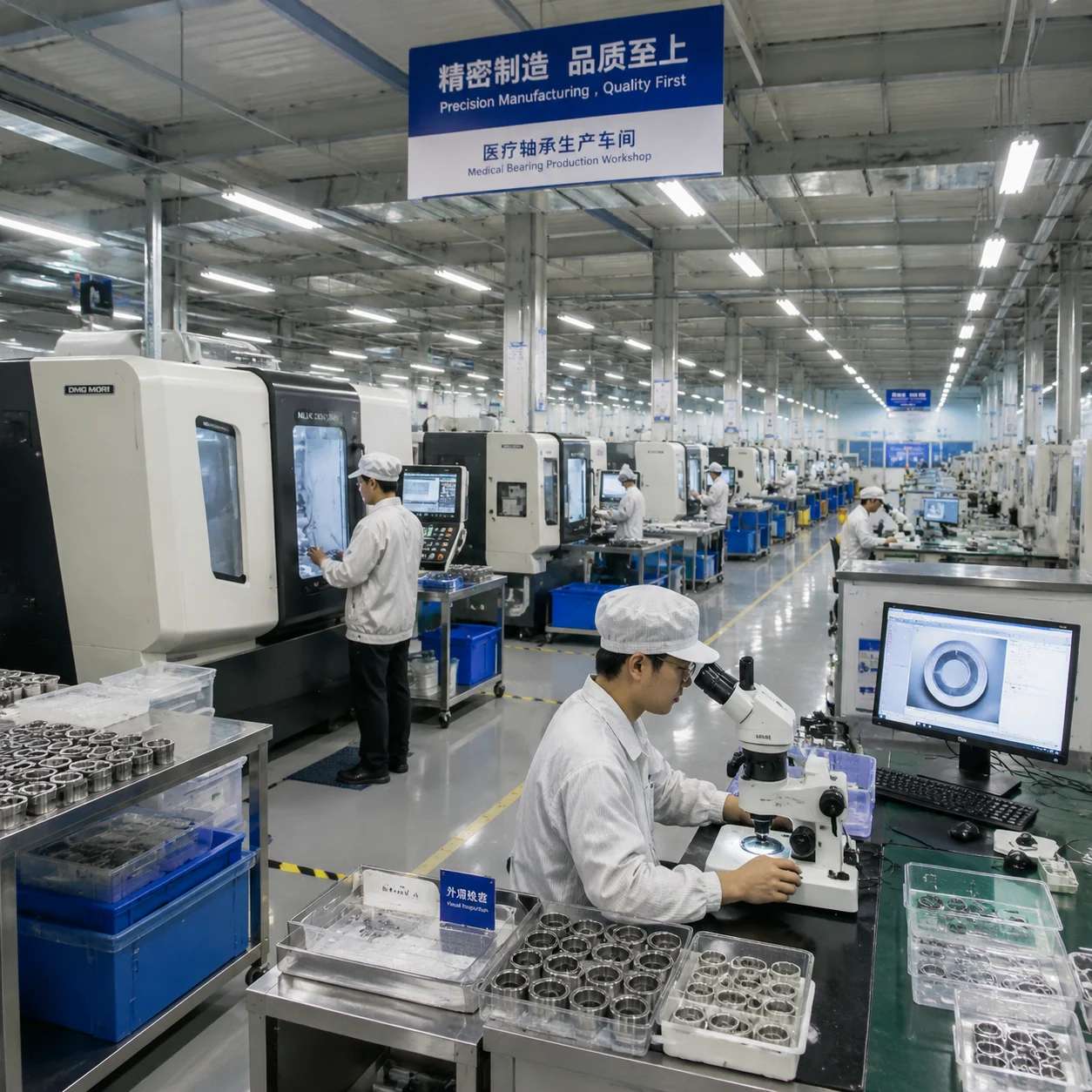
"Our medical device bearing lines undergo continuous precision monitoring, ensuring each batch meets rigorous diagnostic equipment standards."
— JN Bearings Quality Assurance Team20+
Years Manufacturing Experience
100%
Outgoing Quality Inspection
50+
Global Markets Served
OEM
Device Integration Support
Partner with JN Bearings for Medical Applications
We understand that medical equipment procurement demands reliability above all else. JN Bearings provides consistent, high-precision manufacturing to ensure your devices perform flawlessly in critical healthcare environments.
Quality Control & Batch Consistency for Medical Device Bearings
In medical equipment manufacturing, batch-to-batch consistency is critical to maintaining diagnostic accuracy and patient safety. JN Bearings implements a rigorous five-stage quality control process to ensure every precision bearing meets strict tolerances for low noise, minimal vibration, and smooth rotation, from raw material to final shipment.
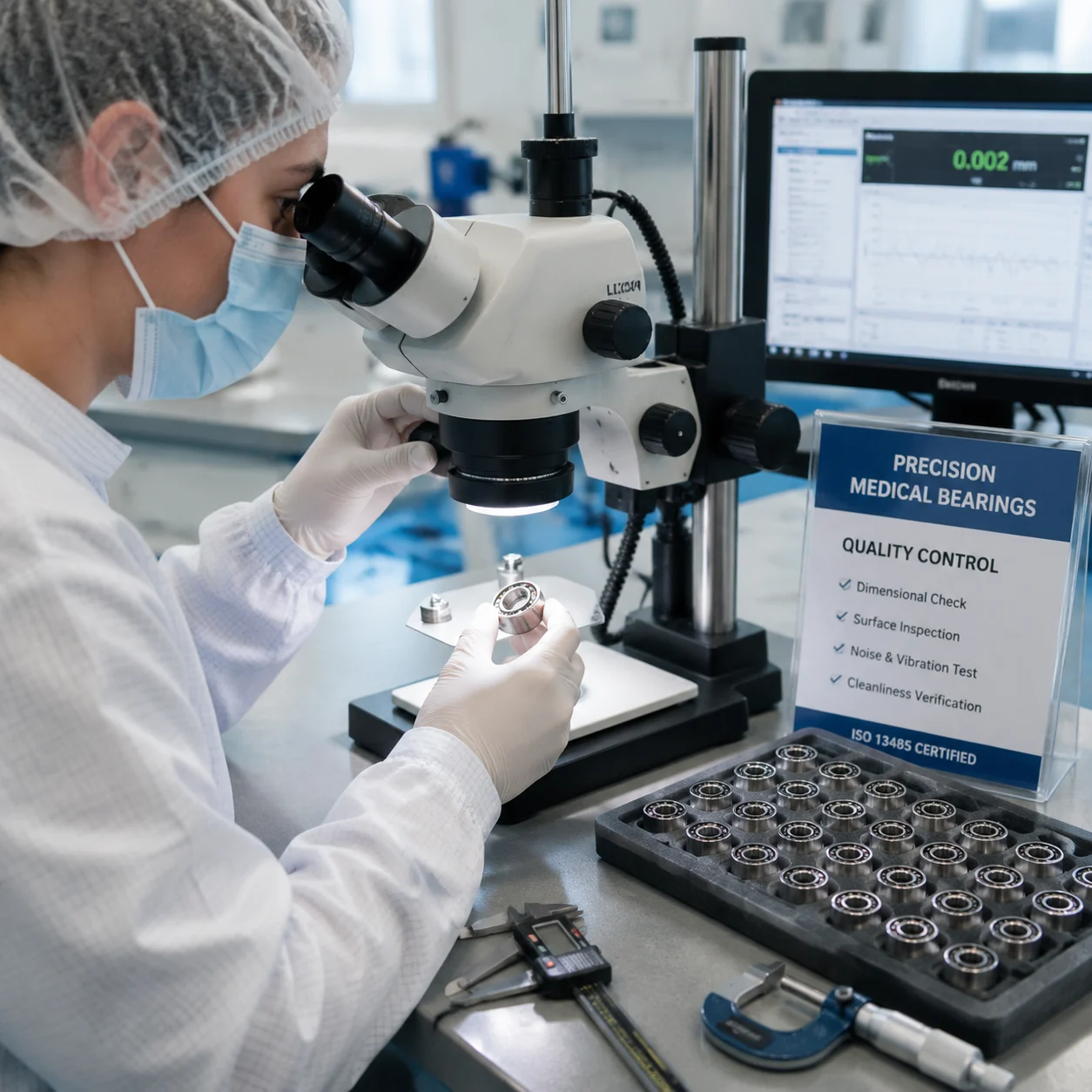
Why Batch Stability is Crucial for Medical Equipment Bearings
Medical imaging systems, surgical robotics, and laboratory centrifuges operate with near-zero tolerance for mechanical deviation. Even slight variations in a bearing's radial runout, noise output, or internal clearance can lead to image artifacts in CT scanners, inaccuracies in robotic arms, or disruptive vibrations in clinical environments.
Relying solely on end-of-line testing is inadequate for high-stakes healthcare applications. JN Bearings integrates process monitoring at every production phase. This continuous oversight guarantees that every unit within a batch—and every subsequent batch—delivers the exact same high precision and quiet operation, resolving the primary challenge procurement teams face when sourcing medical device bearings.
- High precision dimensional accuracy — ensuring identical tolerance levels across an entire production run to maintain equipment alignment.
- Superior surface finish — minimizing friction on raceways and rolling elements to ensure exceptionally quiet bearings and low vibration.
- Contamination-free assembly — controlled environments during assembly to deliver clean room bearings free of particulate matter.
- Comprehensive traceability — complete documentation of batch records and test results to support medical OEM compliance audits.
Five-Stage Manufacturing Control Process
Every order for medical equipment bearings at JN Bearings undergoes a strict five-stage verification protocol. This sequential process isolates variables and prevents defects early, ensuring only flawless components move forward.
Raw Material Verification
Strict analysis of steel grade, hardness, and dimensions prior to manufacturing.
Precision Machining
Advanced CNC grinding paired with in-process gauging to maintain strict tolerances.
Clean Assembly
Verification of clearance, preload, and specialized medical-grade lubrication.
Batch Testing
Comprehensive checks for low noise, minimal vibration, and dimensional compliance.
Protection & Dispatch
Corrosion-resistant packaging, detailed labeling, and final conformance checks.
In-Depth Process Control Standards
Material Inspection & Integrity
Bearing reliability begins with metallurgical integrity. JN Bearings procures high-grade bearing steel and corrosion-resistant stainless steel suited for medical environments. Every incoming lot is tested for hardness, chemical composition, and structural flaws. Any material that fails to meet stringent baseline requirements is immediately quarantined, ensuring substandard steel never enters the machining phase.
- ▸Verification of material hardness against tight medical device specifications
- ▸Pre-machining dimensional checks on bearing rings and rolling elements
- ▸Immediate quarantine protocols for non-conforming raw materials
- ▸Certification validation for 440C stainless steel and specialized alloys
High Precision Machining
High precision bearings require exceptional control over raceway geometry and roundness. Our CNC grinding centers utilize in-process gauging to continuously monitor critical dimensions. By analyzing real-time data, we adjust machinery before tolerances drift. This Statistical Process Control (SPC) guarantees the dimensional consistency required for smooth rotation in medical imaging machinery.
- ▸Continuous in-process gauging during CNC grinding operations
- ▸Strict monitoring of surface finish to ensure low noise performance
- ▸Real-time SPC data logging to identify and correct process drift
- ▸Automated halts if dimensions approach upper or lower tolerance limits
Assembly & Lubrication Control
Proper assembly defines a bearing's operational feel and longevity. We precisely control internal radial clearance and preload for each unit. Because medical environments are sensitive to contamination, assembly takes place in clean conditions. Grease type, fill volume, and shield placement are rigorously verified to guarantee clean room compatibility and maintenance-free operation.
- ▸100% verification of internal clearance and preload during assembly
- ▸Cleanroom-standard handling to eliminate particulate contamination
- ▸Accurate application of specific medical-grade or food-grade lubricants
- ▸Visual and mechanical inspection of shields and seals for secure fitment
Final Noise & Vibration Testing
Before packaging, batches undergo extensive final inspections. We sample production lots to measure noise levels, vibration characteristics, and runout accuracy. Only lots that meet or exceed predefined low noise (e.g., Z2, Z3) and vibration criteria are cleared. Any deviations trigger immediate lot sorting, ensuring your medical devices receive only top-tier components.
- ▸Rigorous noise testing to guarantee quiet bearings for patient environments
- ▸Vibration analysis using advanced measurement equipment
- ▸Radial runout and dimensional checks based on strict AQL standards
- ▸Thorough documentation of test results in traceable batch records
Packaging, Preservation & Dispatch
Preserving precision from the factory to your assembly line is vital. JN Bearings utilizes specialized packaging protocols to protect against corrosion, moisture, and impact damage during global transit. Each unit is individually wrapped and secured to maintain its immaculate surface finish and geometric integrity.
Our final audit verifies that all documentation, including the Certificate of Conformance and batch traceability labels, is accurate. This meticulous dispatch process simplifies incoming quality control for medical device manufacturers, ensuring components are ready for immediate use upon arrival.
- Corrosion prevention — specialized wraps protect steel surfaces from humidity
- Clear traceability — distinct batch labeling detailing production dates and inspection status
- Compliance documentation — Certificates of Conformance provided to streamline your quality audits
- Secure transit packaging — impact-resistant packing designed for safe international shipping
Medical Device Bearing Quality Assurance Matrix
| Production Stage | Key Control Parameters | Inspection Method | Output / Action |
|---|---|---|---|
| Material Integrity | Alloy grade, Rockwell hardness, structural consistency | Hardness testing, metallurgical analysis | Approve for production or quarantine lot |
| Machining Precision | Bore/OD dimensions, roundness, surface roughness | In-process CNC gauging, real-time SPC | Micro-adjust tooling or pause line |
| Clean Assembly | Radial clearance, grease fill rate, shield fitment | Clearance gauges, visual inspection in clean environment | Validate assembly or initiate rework |
| Performance Testing | Acoustic noise, vibration levels, runout accuracy | BVT testing, CMM auditing, standard AQL sampling | Release batch or disposition non-conformities |
| Final Audit & Dispatch | Protective wrapping, labeling accuracy, documentation | Visual QA check, document verification | Issue CoC and authorize shipment |
Proactive Quality Management for Medical Reliability
Manufacturing high precision bearings for medical applications requires more than just rejecting bad parts at the end of the line. It demands a proactive approach to quality. JN Bearings continuously analyzes batch data, monitoring for subtle trends in dimensional variation or noise profiles. By identifying these micro-shifts early, we can recalibrate equipment long before a defect is produced.
This focus on preventative quality control ensures maximum batch-to-batch consistency. For medical OEMs, this translates to reduced risk during equipment assembly, predictable lifecycle performance in the field, and fewer maintenance interventions for critical clinical machinery.
We understand that transparency is essential for medical device manufacturers. JN Bearings readily provides comprehensive inspection reports, material certifications, and customized test data to support your procurement process and facilitate seamless integration into your supply chain.
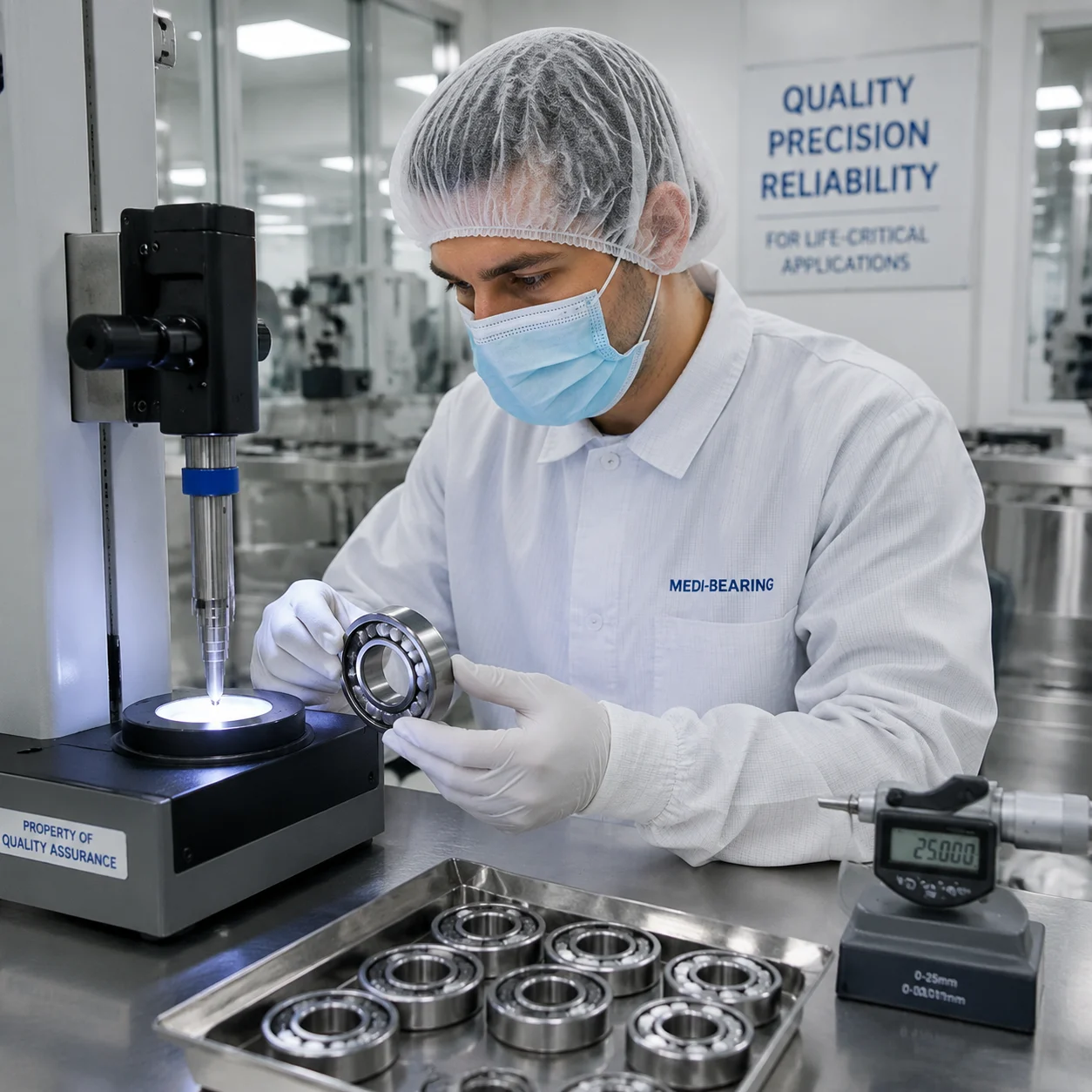
Dedicated to Precision: JN Bearings
By focusing exclusively on ball bearing manufacturing, JN Bearings directs all our engineering expertise, tooling investments, and quality control systems toward perfecting a single product category. This specialization allows us to consistently deliver the ultra-precise, low vibration bearings required for medical devices, diagnostic imaging machinery, and precision surgical instruments.
For procurement professionals, partnering with JN Bearings means fewer supply chain disruptions, simplified vendor qualification, and the confidence that every batch of bearings for medical equipment will perform exactly as specified.
Tell Us About Your Medical Device Bearing Needs
Share your dimensions, speed, load, and environmental requirements. JN Bearings will help you match the right custom bearing solution.
Why Choose JN Bearings?
Specializing in precision ball bearings, we provide tailored, consistent solutions to ensure stable and reliable rotation in demanding medical device applications.
20+
Years in Precision Manufacturing
100%
Quality Consistency Focus
24h
Fast Engineering Response
Submit Your Inquiry
Provide your equipment specifications and we will quickly assess your bearing requirements.
Your details are kept confidential and used only to process your inquiry.
Direct Email Support
sales@jnbearings.com
Fast technical evaluation
WhatsApp Inquiry
Reach out via WhatsApp
For urgent project support
WeChat Support
Connect directly
Easy communication flow