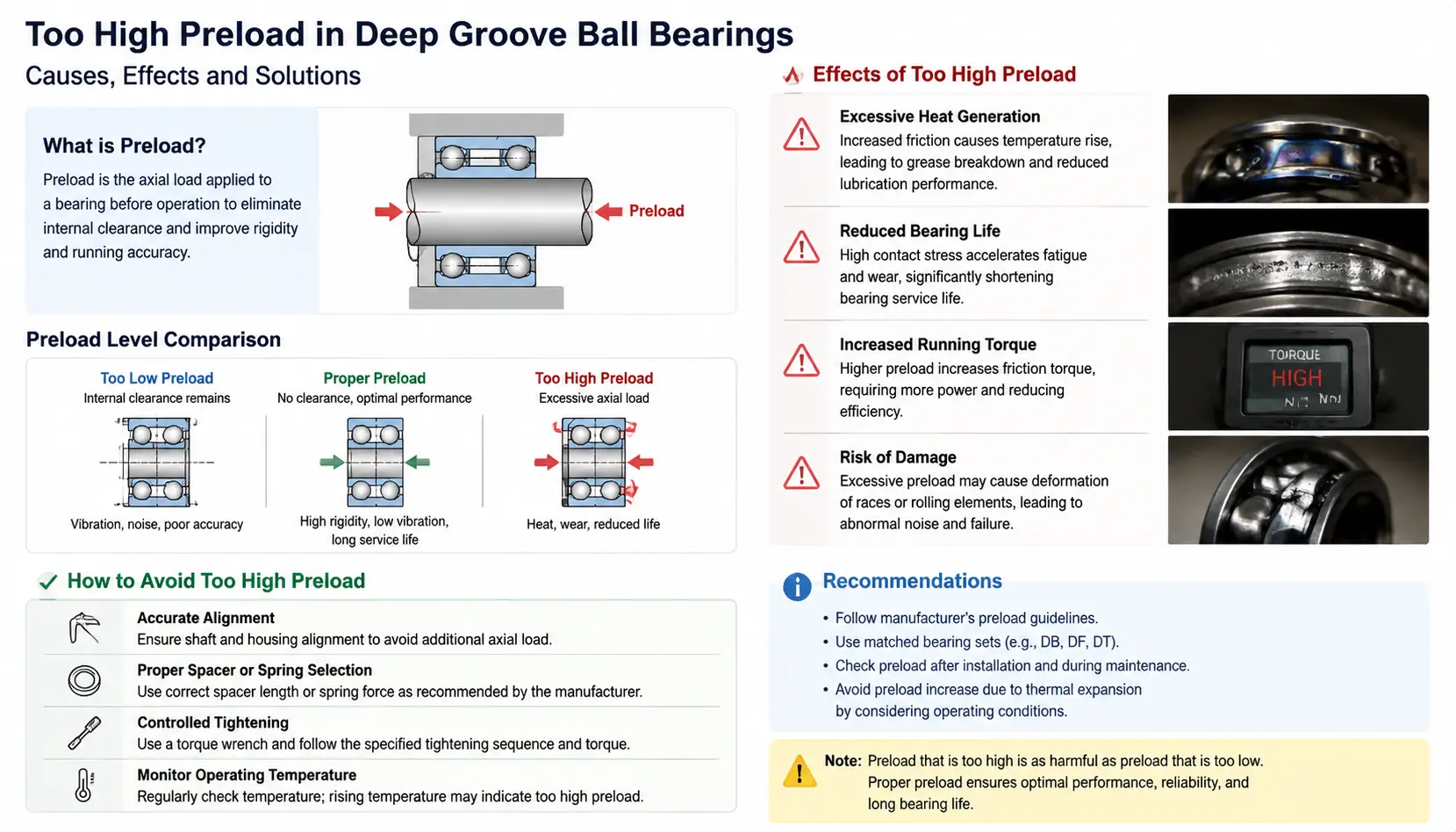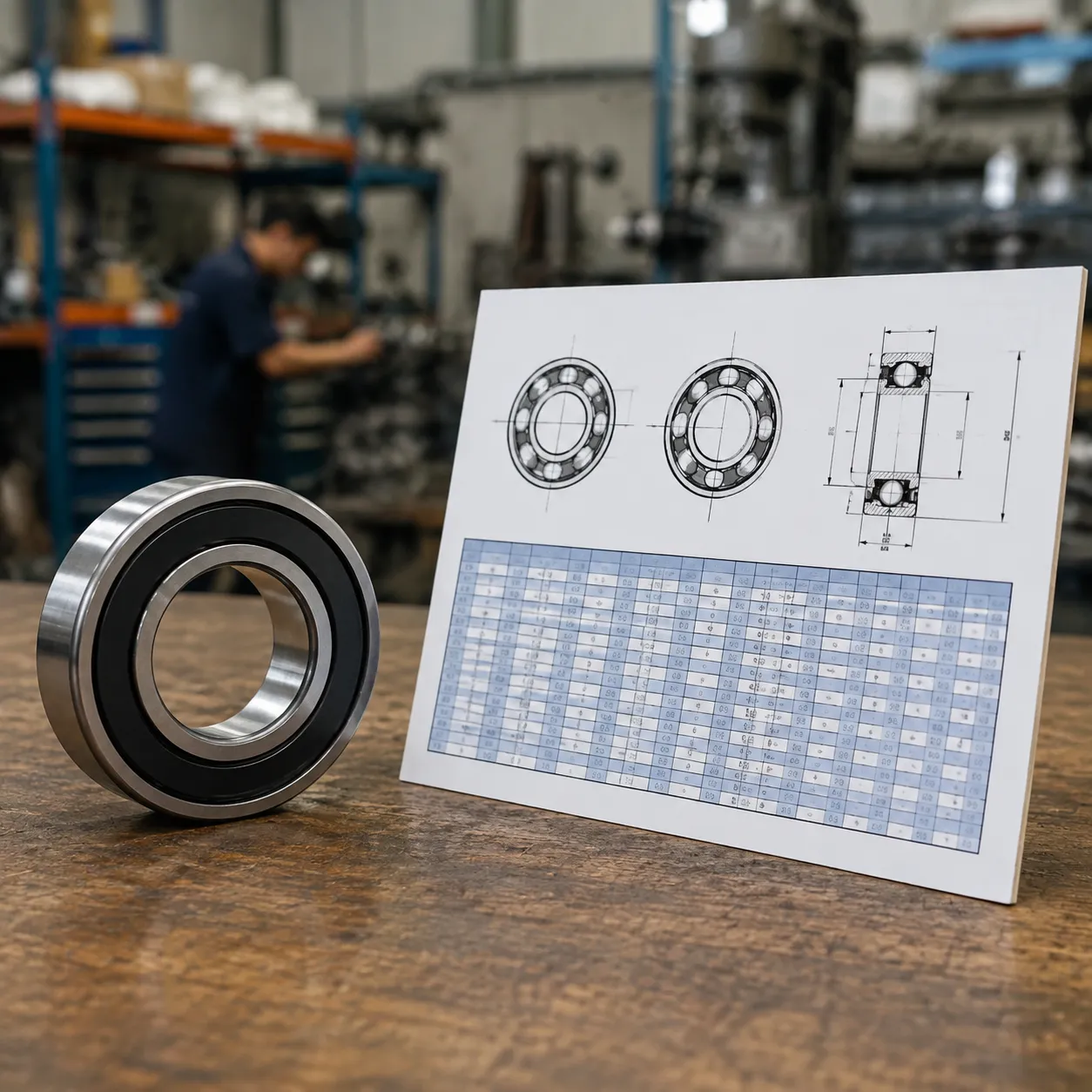
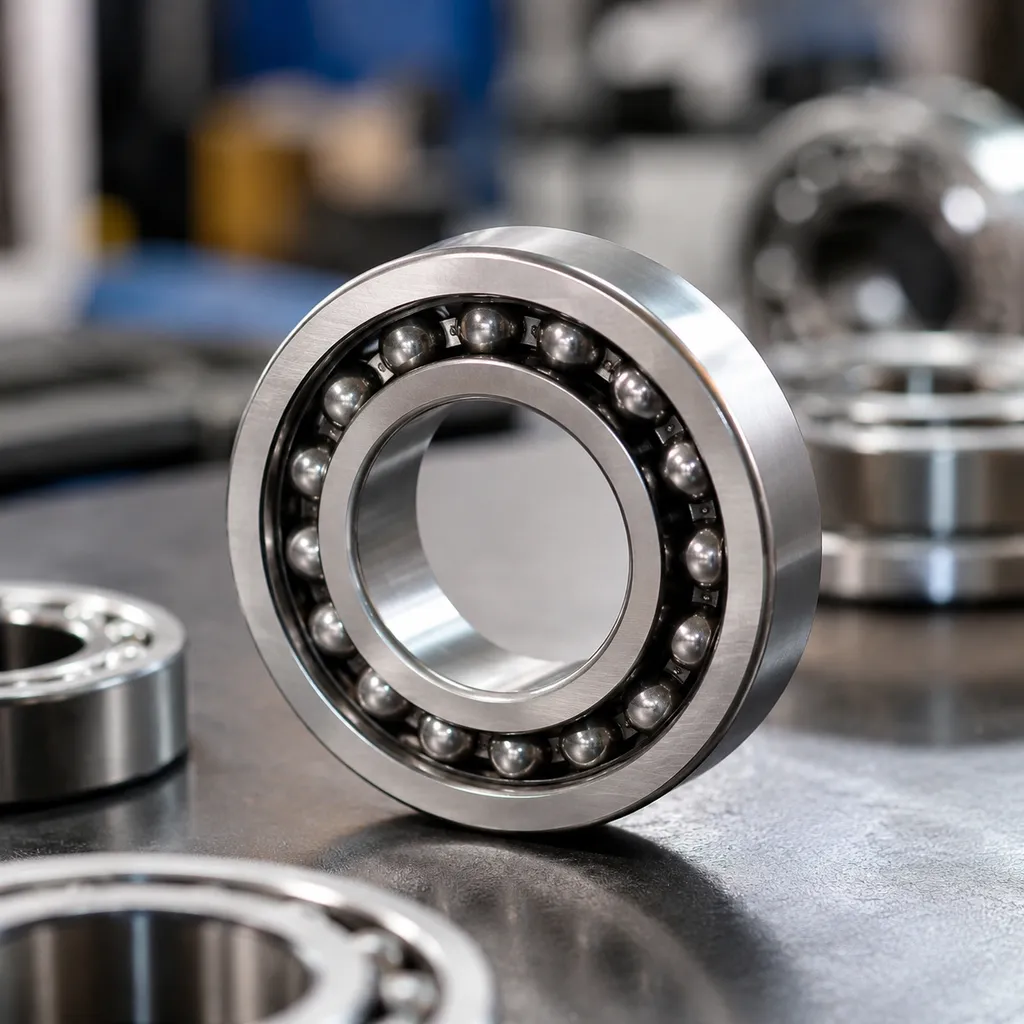
Preloading deep groove ball bearings applies a controlled axial load to remove designed internal clearance—not merely tightening a locknut until the shaft feels stiff.
In scope: High speed application duty, pair of bearings layouts, wave spring / adjusting springs, and setting minimum preload for clearance elimination.
Out of scope: General-duty radial ball bearings that run fine with factory clearance alone under normal radial loads.
Done correctly, preload raises bearing rigidity and bearing stiffness, keeps rolling elements in traction, and limits skidding when load direction or speed changes.
Preloading Deep Groove Ball Bearings: Definition & Mechanics
Standard radial ball bearings are manufactured with a small amount of internal clearance to accommodate shaft fit tolerances and operational heating. High-precision applications cannot tolerate loose play. Preloading a deep groove ball bearing applies a permanent, controlled axial load to the bearing rings during installation, maintaining continuous contact between rolling elements and raceways and transforming standard bearings into high-rigidity assemblies[1]. See parts deep groove ball bearings for ring and ball assembly basics.
Eliminating Radial Clearance for Precision
Uncontrolled play inside a bearing leads to shaft misalignment, vibration, and premature wear. Applying a constant force in the axial direction achieves total clearance elimination.
- Zero Internal Play: Keeps the balls firmly seated against both the inner and outer ring raceways at all times.
- Improved Shaft Alignment: Maximizes bearing rotational rigidity to maintain precise rotational centerlines.
- Vibration Control: Prevents axial and radial float under reversing rotational direction or fluctuating loads.
How Axial Force Shifts Contact Angles
In its free state, a deep groove ball bearing has a nominal ball raceway contact angle of 0°. When you apply an axial preload force, the balls push against the sides of the raceway grooves, shifting the contact angle.
| Load Condition | Contact Angle | Operational Result |
|---|---|---|
| Standard (Unloaded) | 0° | Standard radial support; contains internal play. |
| Preloaded (Axial Force Applied) | Shifts to ~10°–15° | Converts radial clearance into bidirectional bearing stiffness. |
This contact angle shift allows radial ball bearings to resist both radial and axial deflection simultaneously—compare load limits in axial load vs radial load in deep groove ball bearings.
When Standard Internal Clearance Isn't Enough
While standard internal clearance handles general industrial power transmission, precision assemblies demand a dedicated deep groove ball bearing preload. Standard clearance is insufficient when your application involves:
- High speed application: Rapid acceleration can cause ball skidding along the raceway if there is insufficient contact pressure. Motor-grade lines such as high-speed deep groove ball bearings for electric motors often pair with light spring preload.
- Strict Positional Accuracy: Precision equipment, such as medical actuators, robotics, and encoders, requires zero axis drift under changing loads.
- Noise and Vibration Control: Loose rolling elements create high-frequency chatter and acoustic resonance, which preloading completely eliminates.
Why Preload Deep Groove Ball Bearings: Rigidity & Skidding Control
Applying a precise axial load to a preloaded deep groove ball bearing setup transforms mechanical reliability by eliminating internal play and protecting machinery against early failure.
Maximizing Shaft Rigidity and Accuracy
Removing radial play maximizes overall bearing stiffness. This keeps the shaft aligned under changing direction and load, boosting bearing rotational rigidity and holding precise shaft positions.
- Zero axial play: Holds tight tolerances in sensitive drive assemblies.
- Superior runout control: Maintains true concentricity during direction changes.
Eliminating Chatter, Noise, and Vibration
Unloaded rolling elements rattle within the raceway, creating harsh high-frequency noise and vibration. Preload keeps constant contact on every ball for major bearing noise reduction.
- Damped resonance: Kills harmonic chatter at high operating speeds.
- Smoother operation: Eliminates structural rattle across the housing.
Preventing Ball Skidding
During rapid acceleration, loose balls slide across the race instead of rolling, scorching metal surfaces. Maintaining a continuous force prevents skidding entirely.
- Instant rolling traction: Forces immediate ball rotation during rapid speed cycles.
- Surface protection: Prevents scuffing and heat buildup on raceways.

Extending Bearing Fatigue Life
Dynamic shock loads destroy loose bearings by concentrating forces on only one or two balls. Proper preloading distributes operational weight evenly across the entire race.
- Even load distribution: Shares the work across all balls simultaneously.
- Longer service intervals: Prevents premature metal fatigue under heavy dynamic loads.
Spring Preload vs Solid Preload Methods
Choosing the right preloading method for deep groove ball bearings comes down to how the assembly handles thermal expansion, rotational speed, and dynamic loads. Two proven methods dominate: spring preloading and solid preloading.
Spring Preload: Automatic Thermal Expansion Control
Spring preloading uses flexible components like a spring preload wave washer, coil spring, or Belleville spring to apply a continuous axial load against the bearing's outer ring or inner ring.
- Absorbs Thermal Expansion: As operating temperatures rise and the shaft expands, the wave spring flexes to compensate, maintaining stable thermal expansion bearing clearance without binding.
- Constant Axial Tension: Delivers a reliable minimum preload even when manufacturing tolerances or shaft lengths shift slightly.
- Ideal for High-Speed Applications: Because spring tension flexes with temperature changes, it prevents thermal runaway in high-rpm equipment like electric motors, power tools, and small pumps.
Solid Preload: Maximum Rigidity for Heavy Loads
Solid preloading relies on rigid, non-yielding components like precision solid preload shims, ground shaft spacers, or matched bearing rings to clamp a pair of bearings firmly into place.
- Maximum Bearing Stiffness: Clamping the components tightly in place maximizes bearing rotational rigidity, keeping shaft deflection near zero under heavy forces.
- Precise Axial Alignment: Maintains exact shaft positioning under severe reversing forces and dynamic shock loads.
- Requires Precise Machining: Because solid setups cannot yield to thermal expansion, operating temperatures and shaft fit tolerances must be calculated accurately during design to avoid premature wear.
Choosing the Right Preload Method
| Operating Requirement | Spring Preload | Solid Preload |
|---|---|---|
| Primary Advantage | Self-adjusting for thermal changes | Maximum bearing stiffness and positioning accuracy |
| Best Operating Speed | High speed application with light-to-medium loads | Moderate speed with heavy dynamic loads |
| Components Used | Wave washers, Belleville springs | Solid preload shims, ground spacers |
| Thermal Sensitivity | Low (Spring flexes with temperature changes) | High (Requires precise thermal calculations) |
| Typical Equipment | Electric motors, generators, fans | Gearboxes, heavy machinery drives, high-precision spindles |
For most high-rpm applications where operating temperatures fluctuate, spring preloading extends bearing service life. When equipment faces heavy dynamic shock loads or requires extreme positional accuracy, solid preloading delivers the structural stiffness required.
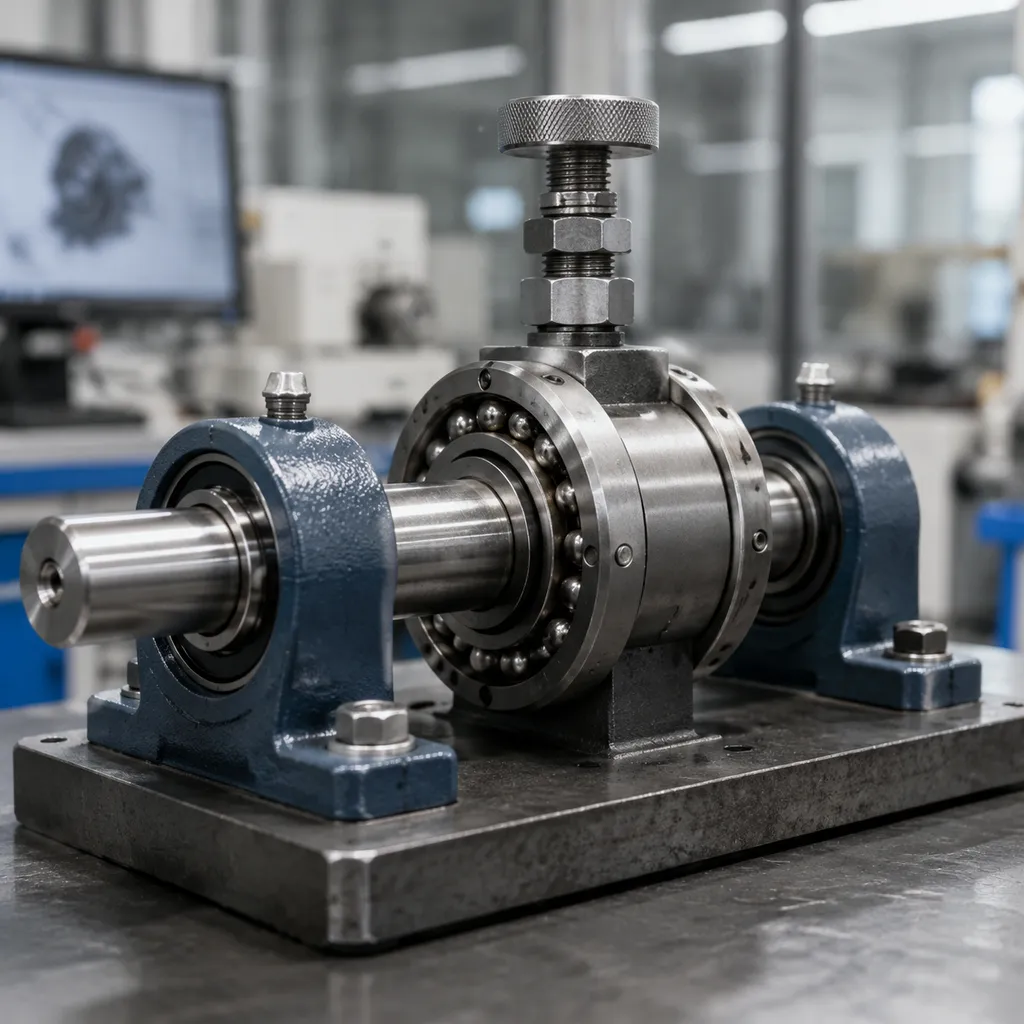
How to Calculate and Choose the Right Preload Force
Getting the right axial preload force comes down to a precise balancing act: enough force to eliminate internal clearance, but not so much that friction torque overheats the assembly. Selection balances bearing stiffness against running friction torque.
Selecting Light, Medium, and Heavy Preload Values
Choosing the correct class depends directly on your application's speed, load, and rigidity requirements:
| Preload Class | Load Range (% Dynamic Capacity) | Typical Application | Key Benefit |
|---|---|---|---|
| Light Preload | 1% – 2% | High speed application, small electric motors | Minimal running friction torque, lowest heat buildup |
| Medium Preload | 3% – 5% | General machinery, gearbox shafts | Balanced bearing rigidity and long service life |
| Heavy Preload | 6% – 10% | High vibration setups, heavy axial loads | Maximum shaft rigidity, zero deflection under dynamic loads |
Accounting for Thermal Expansion and Temperature Changes
Operating temperatures directly impact your total axial load during run time:
- Shaft expansion: The shaft and inner ring usually run hotter than the outer ring and housing. This differential growth increases the internal load on a pair of bearings.
- Thermal calculation: Always calculate expected temperature deltas. A tight solid preload setup at room temperature can rapidly overheat at operating temperatures.
- Spring absorption: If your application experiences wide temperature swings, using a wave spring or adjusting springs helps absorb expansion without spiking the preload force.
Balancing Running Friction Torque Against Bearing Stiffness
- Avoid over-tightening: Higher axial force boosts bearing stiffness, but it exponentially raises friction torque and operating temperatures.
- Calculate minimum preload: Set the axial load just high enough to prevent rolling elements from skidding during rapid acceleration cycles[3].
- Find the sweet spot: Target the lowest possible preload force that maintains continuous ball-raceway contact while keeping system heat to a minimum.
Step-by-Step Installation and Measuring Techniques
Correct installation is essential when preloading deep groove ball bearings to achieve maximum rotational accuracy and long service life. Skimping on proper alignment or guessing your clamp force leads to early fatigue, elevated operating noise, and premature failure.
Proper Axial Alignment During Shaft and Housing Assembly
Misalignment ruins bearing geometry before the shaft even spins. When assembling the setup, follow these core steps to protect rolling elements and raceways:
- Clean and inspect seats: Ensure housing bores and shaft shoulders are free of burrs, rust, and debris.
- Apply force evenly: Always push against the specific ring being press-fitted—apply force to the inner ring for shaft fits, and the outer ring for housing fits. Never transfer mounting force through the balls.
- Maintain axial alignment: Keep the bearing square to the shaft axis during seating. Cocking the outer ring alters the ball raceway contact angle unevenly, creating localized stress points and vibration.
- Seat the bearing pair: When mounting a pair of bearings, lock down the fixed end first before applying your spring preload wave washer or solid preload shims on the floating side.
Measuring Preload Force with Torque Wrenches and Dial Gauges
Guesswork has no place in precision assemblies. Verifying your target axial preload force requires direct measurement during the final clamping process.
| Tool | Measurement Focus | Target Outcome |
|---|---|---|
| Dial Indicator | Axial displacement / endplay | Complete clearance elimination with zero axial endplay under load. |
| Torque Wrench | Fastener clamping force | Precise tightening of locknuts to compress solid preload shims evenly. |
| Rotational Torque Tool | Bearing running friction torque | A smooth, consistent resistance reading that matches target stiffness curves. |
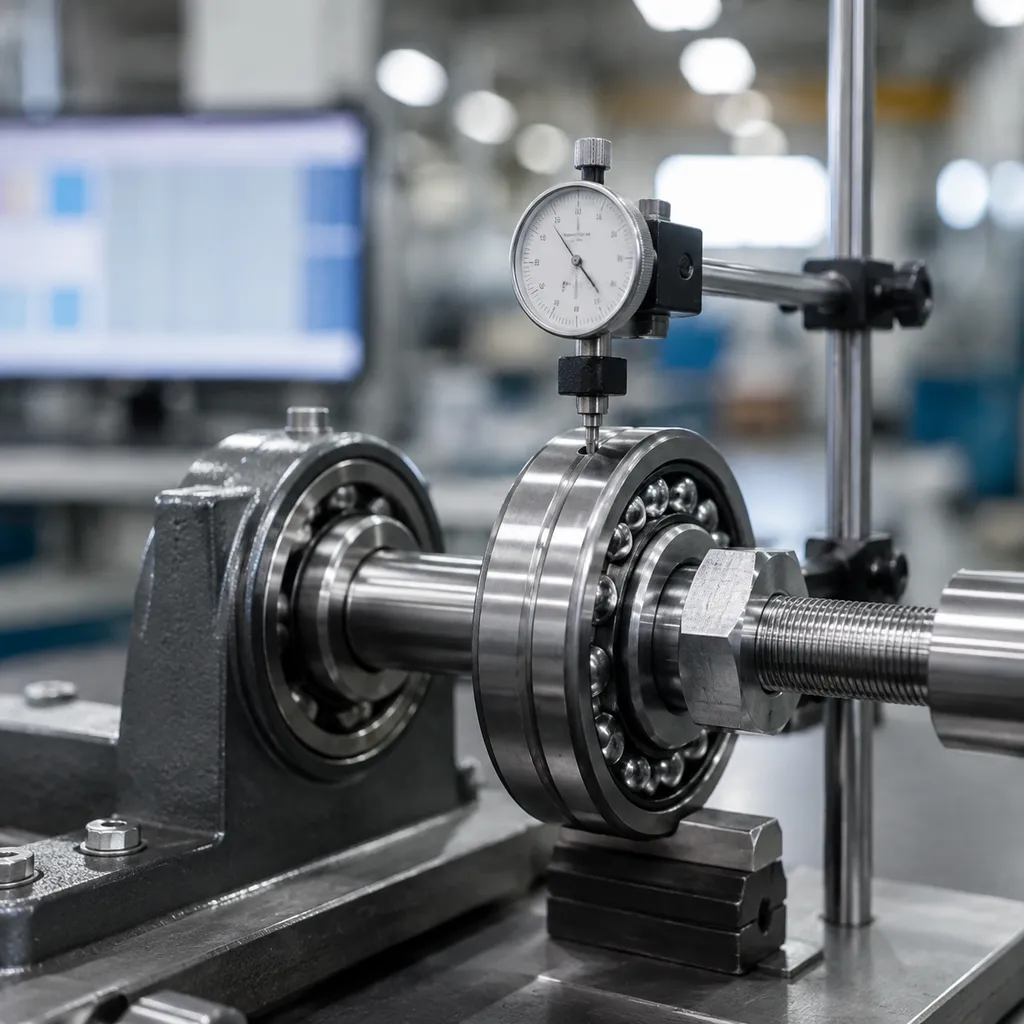
To verify settings, mount a dial gauge against the end of the shaft to measure movement in the axial direction. Slowly tighten the assembly until axial play drops to zero. Next, rotate the shaft by hand to check for a uniform, light drag. Measuring running friction torque confirms the target minimum preload without over-constraining the assembly[2].
Recognizing Signs of Over-Preloading and Excessive Heat Buildup
Applying too much axial load locks up the rolling elements and creates extreme frictional heat. During initial run-in testing, watch for these early warning signs:
- Rapid temperature spikes: If housing temperatures climb rapidly without leveling off, thermal expansion bearing clearance is compromised, risking thermal runaway.
- Increased turning torque: The shaft feels heavy, tight, or notched when turned slowly by hand.
- Abnormal running noise: Excessive pressure on the raceways produces a high-pitched whine or humming noise instead of a smooth rumble.
- Vibration under high speed: Over-tightened assemblies lack the internal clearance needed to absorb minor shaft deflections, leading to noticeable vibration during rapid speed cycles.
If any of these signs appear, stop the equipment immediately. Swap in lighter adjusting springs or add ground spacers to reduce the axial clamping force before permanent raceway damage occurs.
Frequently Asked Questions About Preloading Deep Groove Bearings
Preloading Single-Row Deep Groove Ball Bearings
Yes, you can. While a single radial ball bearing primarily carries radial loads, mounting a pair of bearings in a back-to-back or face-to-face arrangement applies controlled axial load. This axial force shifts the ball-raceway contact angle, effectively achieving complete clearance elimination and maximizing shaft stability.
Risks of Excessive Axial Preload Force
Applying too much preload creates severe operational friction and heat. When you over-preload a bearing assembly, you risk:
- High Running Friction Torque: Drastically increases power consumption and reduces operating efficiency.
- Rapid Thermal Expansion: Trapped heat expands the rolling elements faster than the outer ring can dissipate it, leading to thermal lockup.
- Premature Surface Spalling: Excessive contact pressure shortens overall bearing fatigue life and causes early breakdown.
Choosing Between Spring Preload and Solid Preload
Select the preload method based on speed, temperature shifts, and rigidity requirements:
| Factor | Spring Preload (Wave Springs) | Solid Preload (Precision Shims) |
|---|---|---|
| Primary Advantage | Absorbs thermal expansion automatically | Delivers maximum bearing rigidity |
| Best Application | High-speed applications and light loads | Heavy dynamic loads and precise positioning |
| Deflection Tolerances | High tolerance for shaft growth | Very tight tolerances required |